



When searching for careers in the domain of technology in the Delhi NCR region for the last one year, it is very likely that you would have come across many occurrences of the word “DevOps” in job ads, on LinkedIn profiles, and even in career advisory posts. If you are just starting out in your career as an engineering graduate, a current BCA/B.Tech student, or simply someone working in IT who wants to scale up, then you must be wondering the same thing many other students are right now.
What exactly is DevOps, is it the right career for me, and where do I start?
This guide answers all of those questions honestly and completely. It covers what DevOps actually is, why the Delhi NCR job market is experiencing unprecedented demand for DevOps professionals, what a quality DevOps course in Delhi covers, how to evaluate programs before spending money, and what the career trajectory looks like from enrollment to employment.
If you are a complete beginner, this is the guide you needed before you started searching.
What DevOps Actually Is – And Why the Name Confuses Everyone
DevOps is a compound of Development and Oper ations – the two organizational functions that it bridges. For most of the history of software development, these two functions operated in near-complete isolation from each other. Developers wrote code and threw it over the metaphorical wall to operations teams, who were responsible for deploying and maintaining it in production. The result was slow, unreliable software delivery, frequent deployment failures, and constant conflict between teams whose incentives were fundamentally misaligned.
DevOps emerged as a cultural, philosophical, and technical response to this dysfunction. The core idea is simple: break down the barriers between development and operations by creating shared processes, shared tools, and shared responsibility for the complete software delivery lifecycle from code commit through production deployment and ongoing monitoring.
In practice, a DevOps engineer is the professional who builds and maintains the technical infrastructure that makes fast, reliable, automated software delivery possible. They build the CI/CD pipelines that automatically test and deploy code. They manage the cloud infrastructure where applications run. They containerize applications using Docker and orchestrate them using Kubernetes. They write the infrastructure-as-code that replaces manual server configuration with automated, version-controlled provisioning. They implement the monitoring systems that detect and alert on problems before users notice them.
This is why a quality DevOps course in Delhi covers such a broad toolkit – because the DevOps role itself spans a genuinely broad range of technical domains.
Why Delhi NCR’s Job Market Is Creating Unprecedented DevOps Demand
Understanding the specific demand dynamics in Delhi NCR helps explain why a DevOps course in Delhi represents one of the most strategically timed career investments available to technology students right now.
India’s cloud adoption rate has accelerated dramatically over the past three years. Organizations that were running on-premises infrastructure five years ago are now migrating to AWS and Microsoft Azure at scale. Every cloud migration creates immediate demand for DevOps engineers who can manage cloud infrastructure, build deployment pipelines, and implement the operational practices that cloud-native architecture requires.
Delhi NCR’s concentration of IT services firms, fintech companies, e-commerce platforms, and enterprise technology organizations in Gurgaon and Noida creates a particularly dense hiring market for this specific skill set. According to NASSCOM, Delhi NCR consistently ranks among India’s top three technology employment markets, with cloud and DevOps engineering among the fastest-growing specializations within that market.
The supply-demand imbalance is significant. Traditional computer science education does not cover DevOps tooling in any meaningful depth. Universities teach programming, data structures, and algorithms – not Docker, Kubernetes, Terraform, or Jenkins. This creates a structural gap between the number of organizations that need DevOps engineers and the number of graduates who have the specific toolchain knowledge to fill those roles. Completing a quality DevOps course in Delhi positions you directly in that gap – in the market where demand is highest and supply is most constrained.
The Complete DevOps Toolchain – What You Actually Need to Learn
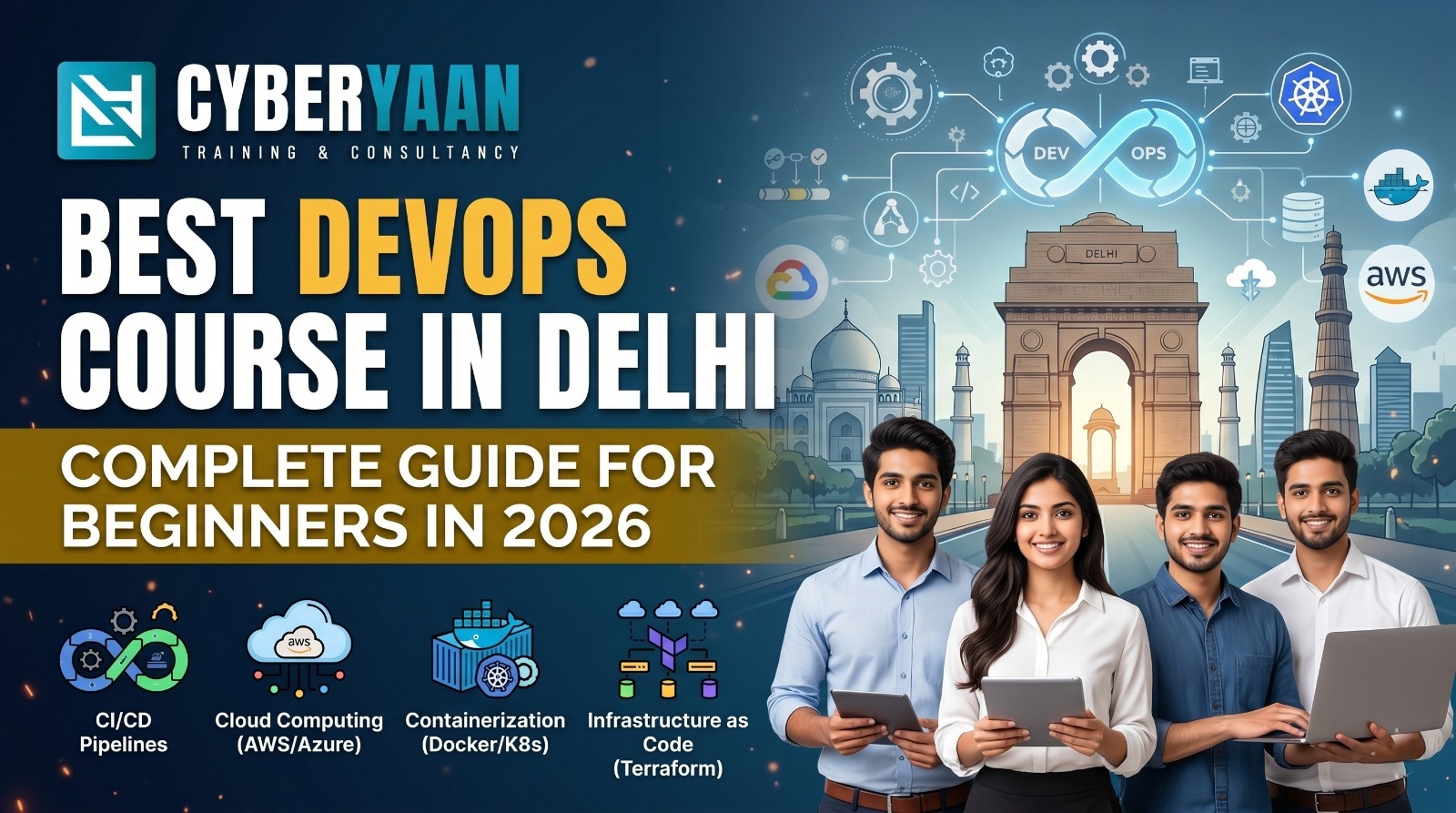
One of the most common questions from beginners considering a DevOps course in Delhi is what the learning actually involves. Here is a breakdown of the core technical domains that every complete DevOps curriculum must cover.
Linux Administration forms the non-negotiable foundation. Every cloud server, every container, and every Kubernetes node runs Linux. DevOps engineers who are not comfortable in a Linux terminal cannot function effectively in any real production environment. Understanding file system management, process control, user administration, networking commands, and service management is prerequisite knowledge for every other tool in the DevOps stack.
Cloud Infrastructure – specifically AWS and Microsoft Azure – is where most DevOps work actually happens. Understanding EC2 instances, S3 storage, VPC networking, IAM permissions, and the core cloud services that production applications run on is essential. AWS is the dominant cloud platform globally and Microsoft Azure is the primary choice for enterprise organizations in India’s corporate sector – which is why a quality DevOps course in Delhi covers both. Amazon Web Services and Microsoft Azure both provide documentation and free tier resources that support hands-on learning.
Docker and Kubernetes are the containerization and orchestration tools that define modern cloud-native application deployment. Docker allows applications to be packaged with all their dependencies into portable containers that run consistently across any environment. Kubernetes manages the deployment, scaling, and lifecycle of those containers at enterprise scale. The Certified Kubernetes Administrator (CKA) certification is one of the most recognized and most valuable credentials a DevOps engineer can hold – and a serious DevOps course in Delhi will align its Kubernetes training with CKA objectives. The Linux Foundation administers the CKA examination and provides authoritative guidance on what the certification validates.
CI/CD Pipelines – built with Jenkins and GitLab CI/CD – are the automated delivery systems that allow organizations to go from code commit to production deployment reliably and repeatedly. Building, testing, and deploying software automatically rather than manually is the operational core of what DevOps engineering means in practice. Jenkins is the most widely deployed open-source CI/CD tool and understanding it deeply is one of the most directly employable skills a DevOps engineer can develop.
Infrastructure as Code using Terraform is the practice of defining and provisioning cloud infrastructure through code rather than manual console configuration. Terraform’s declarative syntax allows entire cloud environments to be version-controlled, reviewed, and reproduced consistently – eliminating the manual configuration drift that causes production incidents. HashiCorp provides comprehensive official documentation for Terraform that practicing DevOps engineers refer to throughout their careers.
Ansible Automation handles configuration management and application deployment across multiple servers – ensuring that every server in an environment is configured identically and that configuration changes can be applied consistently at scale without manual intervention.
Monitoring with Prometheus and Grafana provides the observability that production DevOps teams need to maintain system reliability. Prometheus collects metrics from applications and infrastructure. Grafana visualizes those metrics in dashboards. Alertmanager triggers notifications when metrics exceed defined thresholds. Together they form the monitoring stack that keeps production systems running reliably.
Shell Scripting and Python for DevOps provide the automation scripting capability that DevOps engineers use daily – writing deployment scripts, parsing log files, building custom tooling, and integrating different systems through APIs.
What a Complete DevOps Course in Delhi Should Include
Knowing what to look for in a DevOps course in Delhi is as important as knowing what the field involves. The quality variation across programs in Delhi is significant enough that choosing the wrong program can cost you significant time and money without producing employable skills.
Hands-on lab access throughout the complete course duration is the single most important factor. DevOps is an entirely practical discipline. Watching demonstrations of Docker, Kubernetes, and Terraform is dramatically less valuable than actually running those tools against real infrastructure. Any DevOps course in Delhi that does not include dedicated lab environments where students work with real tools in real cloud environments throughout every module is not developing the skills that technical interviews test for.
Real-time project work is essential. The gap between knowing how individual tools work and knowing how to integrate them into a complete, production-grade DevOps pipeline is large – and it only closes through project experience. A DevOps course in Delhi that includes a dedicated real-time project module where students build and deploy a complete application using the full DevOps toolchain produces graduates with portfolio evidence that hiring managers can evaluate directly.
Practitioner trainers with active industry experience are what separate programs that develop genuine capability from those that teach theoretical tool knowledge. A DevOps engineer who has managed production Kubernetes clusters at a real organization brings context, judgment, and practical troubleshooting knowledge that no textbook or documentation can replicate.
Cloud platform coverage for both AWS and Microsoft Azure reflects the reality of the Delhi NCR job market – where different organizations use different primary cloud platforms and a DevOps engineer who knows only one is less competitive than one who knows both.
Certification preparation – specifically for CKA (Certified Kubernetes Administrator), AWS Solutions Architect or DevOps Engineer certifications, and HashiCorp Terraform Associate – significantly strengthens the career outcome of any DevOps course in Delhi by providing recognized credentials that hiring managers use as screening criteria.
Placement support that is structured and genuine rather than a verbal promise – including resume building for DevOps roles, mock technical interviews, and direct connections to hiring companies in Delhi NCR – is what converts training into employment.
The Career Path From a DevOps Course in Delhi
Understanding the career trajectory that a DevOps course in Delhi enables helps students and their parents evaluate the investment rationally rather than speculatively.
At the entry level, fresh graduates of a quality DevOps course in Delhi with hands-on experience and relevant certifications are competitive for roles including Junior DevOps Engineer, Cloud Support Engineer, Site Reliability Engineer (Junior), and Build and Release Engineer. Starting salaries for these roles in Delhi NCR range from Rs 4 to Rs 7 LPA – notably higher than most other entry-level IT roles because of the specific toolchain knowledge that DevOps positions require.
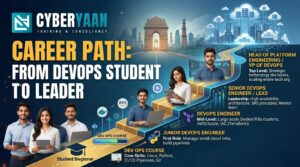
With 1 to 3 years of professional experience, DevOps engineers in Delhi NCR regularly reach Rs 8 to Rs 15 LPA as they develop deeper expertise in cloud architecture, Kubernetes administration, and CI/CD pipeline design. This growth pace is faster than most other technology career tracks because the combination of demand and genuine skill scarcity creates continuous upward pressure on compensation.
At the senior level – 3 to 5 years of experience with advanced certifications including CKA, AWS DevOps Engineer Professional, or Azure DevOps Expert – salaries reach Rs 15 to Rs 30 LPA and beyond. Senior DevOps engineers, SRE leads, and cloud architects at Delhi NCR technology firms command compensation that exceeds most other mid-career technology specializations.
Who Should Consider a DevOps Course in Delhi
A DevOps course in Delhi is particularly well-suited for specific profiles – and understanding this helps set accurate expectations.
Fresh BCA, MCA, and B.Tech graduates who want to differentiate themselves from the large pool of computer science graduates competing for general software development roles will find that DevOps specialization creates a significantly more competitive job market position. The toolchain knowledge from a quality DevOps course in Delhi is not taught in any undergraduate program – which means the specialization is immediately differentiating.
Software developers who want to expand their scope and move toward infrastructure and platform engineering find DevOps training a natural and highly valuable extension of their existing skills. Understanding how to build, deploy, and operate the infrastructure that runs their code makes them more complete and more senior engineers.
Career switchers from non-technical backgrounds will find the DevOps course in Delhi more challenging without prior programming or systems experience but still achievable with the right foundation-building approach – starting with Linux and Python fundamentals before moving into the more advanced toolchain modules.
Practical Steps to Get Started
Before enrolling in any DevOps course in Delhi, spend two to three weeks on foundational preparation that will make the course significantly more productive. Install Ubuntu Linux in VirtualBox and practice basic terminal commands daily. Create a free AWS account and explore the console. Read the official Docker getting started guide to understand containerization concepts before your first lab session.
This preparation does not replace the structured training – it accelerates your progress through the foundational modules so you can spend more cognitive energy on the advanced concepts where genuine expertise is built.
Cyberyaan’s DevOps course in Delhi covers all 14 modules of the complete DevOps toolchain – from Linux administration through Docker, Kubernetes, Jenkins, Terraform, Ansible, AWS, Azure, GitLab CI/CD, Shell Scripting, Python for DevOps, Prometheus monitoring, and a dedicated real-time project – with hands-on lab access throughout and structured placement support connecting graduates with Delhi NCR’s DevOps hiring market.
Conclusion
The DevOps course in Delhi landscape in 2026 offers one of the most clearly structured career entry points available in India’s technology sector – for students who choose the right program and approach their training with the consistency and hands-on practice that the field requires.
The demand is real and structural rather than cyclical. The supply shortage is genuine and unlikely to close quickly through conventional education channels. The salary trajectory is among the strongest in the technology sector. And the geographic concentration of DevOps-hiring companies in Delhi NCR’s Gurgaon and Noida corridors makes the career pathway from training to employment more direct than in almost any other technology market in India.
The complete guide you just read is the starting point. The hands-on lab work, the real-time project, and the structured learning pathway of a quality DevOps course in Delhi is where the career actually gets built.
📞 +91-7428748576 📧 training@cyberyaan.com 🌐 cyberyaan.com/Diploma/devOps-Course-in-Delhi.html