
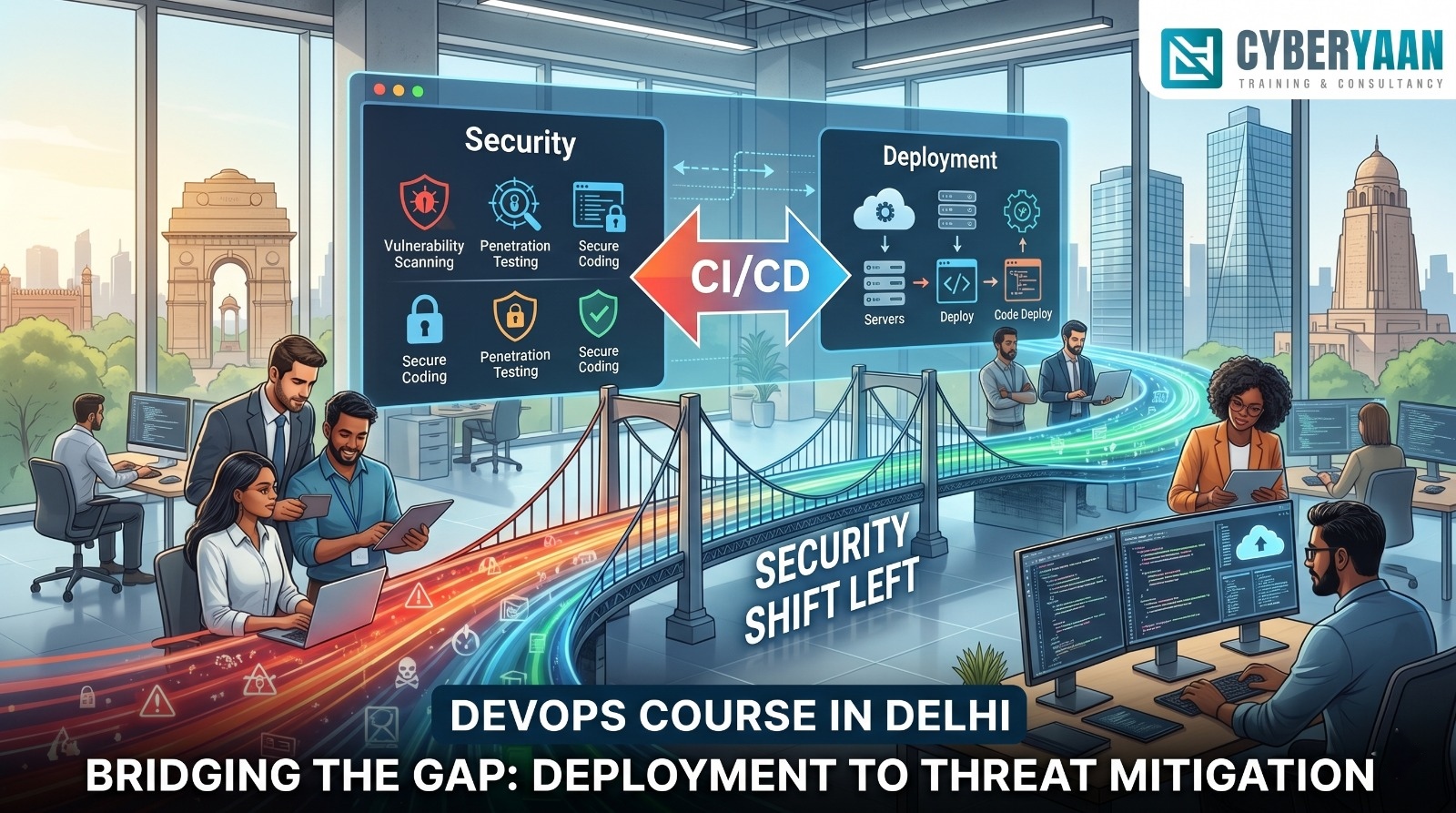
This moment will come for any software company in the maturity process when their “build now, fix security issues later” approach becomes unsustainable. Usually, it comes after a successful attack on the product. After an auditing failure. And sometimes after sending back a sprint for the third time in a row because of discovering a major vulnerability in the last three days before deployment.
The response to this moment is always the same: we need to move security earlier in the process. We need to stop treating it as a final checkpoint and start treating it as a continuous practice woven through every stage of development and deployment.
This is what Shifting Security to the Left means. And it is the philosophy that has transformed DevOps into DevSecOps – the discipline that a quality DevOps course in Delhi must prepare every student to understand and implement.
This blog explains what shifting left means in practice, why DevSecOps is replacing standard DevOps as the expected competency for senior engineering roles, how automated security verification checkpoints work inside a deployment pipeline, and why completing a DevOps course in Delhi that includes DevSecOps methodology positions you at the front of one of the most rapidly evolving and most in-demand specializations in India’s technology market.
What Does “Shifting Security to the Left” Actually Mean?
In traditional software development, the process flows left to right across a timeline. Requirements are gathered on the left. Development happens in the middle. Testing happens near the right. Deployment happens at the far right. Security – when it was considered at all – happened at the very end, after everything else was done and before the code went live.
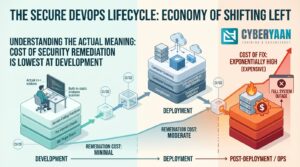
The problem with this model is structural. By the time a security vulnerability is discovered at the right end of the pipeline, it has been built into the codebase by developers who did not know it was a problem, tested around by QA teams who were not looking for it, and is now embedded in infrastructure configuration that needs to be redesigned rather than patched. The cost of fixing a security defect discovered at deployment is exponentially higher than fixing the same defect discovered at the code writing stage.
Shifting left means moving security activities toward the left side of that timeline – into design, into coding, into the earliest stages of build and test automation – so that vulnerabilities are caught when they are cheapest to fix rather than when they are most expensive to remediate.
A DevOps course in Delhi that teaches only the operational side of DevOps – CI/CD pipeline construction, container orchestration, infrastructure as code – without integrating security methodology into each of those activities is teaching a version of DevOps that the industry has already moved beyond.
Why DevSecOps Is Replacing Standard DevOps as the Market Standard
The transition from DevOps to DevSecOps is not a future trend – it is a present reality in Delhi NCR’s enterprise technology market.
The NASSCOM India Tech Report identifies DevSecOps as one of the fastest-growing competency requirements across Indian IT services firms, product companies, and cloud-native organizations. The driver is straightforward: every organization that has adopted DevOps practices and achieved fast, automated deployment has discovered that fast, automated deployment of insecure code is significantly worse than slow deployment of secure code.
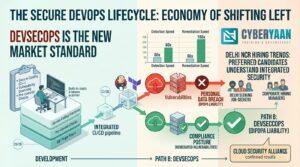
The regulatory environment has accelerated this realization. India’s Digital Personal Data Protection Act creates legal liability for organizations that deploy applications with security vulnerabilities that lead to personal data breaches. An organization that can demonstrate that security testing was integrated into its CI/CD pipeline and that vulnerabilities were systematically identified and remediated before deployment has a significantly stronger compliance posture than one that relies on periodic manual security reviews.
For students completing a DevOps course in Delhi, this market shift has direct career implications. Job postings for DevOps engineers in Delhi NCR increasingly specify DevSecOps knowledge alongside the core toolchain requirements of Docker, Kubernetes, Jenkins, and Terraform. The candidates who understand both the operational automation and the security integration are consistently preferred over those who understand only the automation.
The Cloud Security Alliance DevSecOps guidance confirms that organizations adopting integrated security automation in their deployment pipelines detect vulnerabilities 60 times faster and remediate them 168 times faster than those relying on separate security reviews. These are the outcomes that enterprise hiring managers are trying to achieve and the professionals who can deliver them are precisely what a quality DevOps course in Delhi should produce.
The DevSecOps Pipeline – Understanding the Architecture
Before examining the specific security checkpoints within a deployment pipeline, it helps to understand the overall DevSecOps pipeline architecture and how it differs from a standard DevOps pipeline.
A standard DevOps pipeline moves code through stages: source control, build, test, staging, and production. Security is an afterthought – perhaps a manual review before the final production push if resources allow.
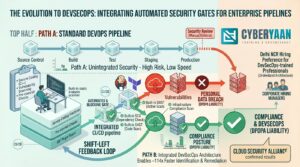
A DevSecOps pipeline embeds automated security verification at every stage. The pipeline does not simply ask “does the code work?” at each stage – it simultaneously asks “does the code work AND does it introduce security risks?”
The key architectural difference is that security gates are automated and blocking. A security failure in a DevSecOps pipeline stops the deployment in the same way that a failing unit test stops a standard DevOps pipeline. This automation is what makes the shift-left philosophy operationally viable at the deployment speeds that modern organizations require.
The 8 Automated Vulnerability Verification Checkpoints Inside a DevSecOps Pipeline
This is the structured implementation that separates theoretical shift-left understanding from practical DevSecOps capability – and it is the specific knowledge that differentiates a DevOps course in Delhi that includes DevSecOps from one that does not.
Checkpoint 1 – Pre-Commit Security Hooks
Where it happens: Developer workstation, before code reaches version control
What it does: Pre-commit hooks run automated security checks on code changes before the developer can commit to the repository. These checks include secret detection – scanning for accidentally included API keys, passwords, or private certificates – and basic static analysis for obvious security anti-patterns.
Tools used: Git hooks, Gitleaks for secret detection, pre-commit framework
What it catches: Hardcoded credentials, private keys committed to version control, obvious injection vulnerabilities
Why it matters: This is the earliest possible intervention point. A secret detected before it reaches version control history is infinitely easier to remediate than one discovered after it has been committed, pushed, potentially cloned by other developers, and may have been exposed in CI/CD logs.
Checkpoint 2 – Static Application Security Testing (SAST) in the Build Stage
Where it happens: CI/CD pipeline, immediately after the build step
What it does: SAST tools analyze source code without executing it, identifying vulnerability patterns including SQL injection risks, cross-site scripting vectors, insecure cryptographic implementations, and dangerous function usage.
Tools used: SonarQube (open source), Checkmarx, Semgrep
What it catches: OWASP Top 10 vulnerability patterns in source code, insecure coding practices, deprecated function usage, injection vulnerability patterns
Pipeline integration: The SAST stage is configured to fail the pipeline build if findings exceed a defined severity threshold. Critical findings always block deployment. High findings may block or warn depending on organizational policy.
Checkpoint 3 – Software Composition Analysis (SCA)
Where it happens: CI/CD pipeline, alongside or immediately after SAST
What it does: SCA tools scan all third-party libraries, open-source packages, and dependencies included in the application against known vulnerability databases. Every npm package, Python pip dependency, or Java Maven artifact has a known vulnerability profile that SCA tools check against current CVE databases.
Tools used: OWASP Dependency-Check, Snyk, Dependabot
What it catches: Known vulnerabilities in third-party libraries, outdated dependencies with published CVEs, license compliance issues
Why it matters: The Log4Shell vulnerability in 2021 – which affected tens of thousands of applications globally – was a dependency vulnerability. An SCA checkpoint integrated into the pipeline would have identified Log4j versions affected by Log4Shell during the build process, before deployment. The OWASP Dependency-Check tool is free, widely trusted, and integrates directly into Jenkins and GitLab CI/CD pipelines.
Checkpoint 4 – Container Image Security Scanning
Where it happens: CI/CD pipeline, after the Docker image build step
What it does: Container image scanners analyze the complete contents of a Docker image – the base operating system layer, installed packages, and application code – for known vulnerabilities before the image is pushed to the registry or deployed to Kubernetes.
Tools used: Trivy, Grype, Docker Scout, Aqua Security
What it catches: Vulnerable packages in the base OS layer, outdated system libraries, misconfigurations in the container build file
Pipeline integration: The image scanning stage prevents images with Critical or High severity vulnerabilities from being pushed to the container registry. Only images that pass the security threshold are tagged and made available for deployment.
Checkpoint 5 – Infrastructure as Code Security Scanning
Where it happens: CI/CD pipeline, before Terraform apply or CloudFormation deployment
What it does: IaC security scanners analyze Terraform files, CloudFormation templates, Kubernetes manifests, and Ansible playbooks for security misconfigurations before the infrastructure is actually provisioned. An S3 bucket configured with public access, a security group rule allowing unrestricted inbound traffic, or a Kubernetes pod running with privileged access are all detectable at the IaC stage before they create actual security exposure.
Tools used: Checkov, tfsec, Terrascan, KICS
What it catches: Cloud misconfiguration risks, overly permissive IAM policies, insecure network configuration, Kubernetes security context misconfigurations
Why it matters: The majority of cloud security breaches are caused by misconfiguration rather than sophisticated attacks. IaC security scanning catches misconfigurations at the definition stage – before they are deployed and potentially exploited.
Checkpoint 6 – Dynamic Application Security Testing (DAST) in the Staging Environment
Where it happens: Staging environment, after deployment to pre-production
What it does: DAST tools test the running application from the outside – simulating the perspective of an attacker making real HTTP requests to the application. Unlike SAST which analyzes code, DAST finds vulnerabilities that only manifest at runtime: authentication bypass opportunities, session management weaknesses, and injection vulnerabilities that depend on application state.
Tools used: OWASP ZAP (free, open source), Burp Suite Enterprise, Nuclei
What it catches: Runtime authentication vulnerabilities, session management issues, server-side injection vulnerabilities, insecure HTTP headers, business logic flaws visible through the API
Pipeline integration: DAST is typically run as an automated scan against the staging environment after deployment and before promotion to production. The OWASP ZAP scanner has a dedicated CI/CD integration mode that runs in headless fashion and outputs findings in machine-readable formats for pipeline consumption.
Checkpoint 7 – Secrets and Configuration Validation in the Runtime Environment
Where it happens: Pre-production validation, immediately before production deployment
What it does: This checkpoint validates that the production deployment configuration does not contain hardcoded secrets, that all required security environment variables are present, that TLS certificates are valid and not approaching expiration, and that security-relevant configuration values match their expected secure defaults.
Tools used: Vault by HashiCorp for secrets management, custom pipeline scripts, conftest for policy validation
What it catches: Last-minute configuration errors, expired or invalid certificates, missing security configuration, secrets that escaped earlier detection
Why it matters: Even with all earlier checkpoints in place, configuration errors at deployment time represent a final class of security risk. This checkpoint ensures that what reaches production is configured securely regardless of what development environments contained.
Checkpoint 8 – Continuous Security Monitoring in Production
Where it happens: Production environment, continuously after deployment
What it does: This is not a blocking checkpoint but an ongoing security verification layer that monitors deployed applications and infrastructure for new vulnerabilities, anomalous behavior, and emerging threats in real time.
Tools used: Prometheus for metrics collection, Grafana for visualization, SIEM platforms including Splunk and Microsoft Sentinel, cloud-native monitoring including AWS GuardDuty and Azure Defender
What it catches: New CVEs affecting deployed dependencies, anomalous traffic patterns indicating active exploitation attempts, configuration drift from secure baselines, emerging threat patterns
Why it matters: The threat landscape changes continuously. A deployment that was secure on Monday may be vulnerable on Wednesday if a new CVE is published for a component it uses. Continuous monitoring closes the gap between deployment and ongoing threat awareness.
How a Quality DevOps Course in Delhi Develops These Capabilities
Understanding the eight checkpoints described above is one level of knowledge. Being able to implement them in a real CI/CD pipeline using the actual tools and configurations that enterprise organizations use is a completely different level – and it is the level that a quality DevOps course in Delhi must develop.
Cyberyaan’s DevOps course in Delhi covers the complete DevOps toolchain – Docker, Kubernetes, Jenkins, GitLab CI/CD, Terraform, Ansible, AWS, Azure, Prometheus, Shell Scripting, and Python for DevOps – with hands-on lab environments throughout the program. The DevSecOps integration that this blog describes is not a separate subject but the practical application of combining these tools in security-aware configurations.
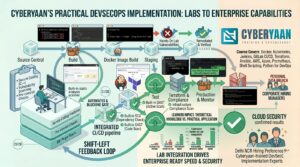
A Jenkins pipeline that includes a SonarQube SAST stage. A Docker image build process that includes a Trivy scanning step. A Terraform workflow that includes a Checkov validation stage. A Prometheus monitoring configuration that alerts on security-relevant metrics. These are not theoretical concepts in Cyberyaan’s program – they are hands-on lab exercises that students execute in real environments.
The combination of operational DevOps skill and security integration capability is precisely the profile that Delhi NCR’s enterprise technology organizations are trying to hire – and precisely what a comprehensive DevOps course in Delhi should produce.
The Career Value of DevSecOps Expertise in Delhi NCR
The career outcome difference between a DevOps engineer who understands security integration and one who does not is significant and measurable in the Delhi NCR job market.
Standard DevOps engineer roles in Delhi NCR for certified freshers with hands-on experience start at Rs 4 to Rs 7 LPA. DevSecOps engineers with demonstrable pipeline security integration skills – the ability to implement SAST, DAST, SCA, and container scanning in production CI/CD pipelines – command Rs 6 to Rs 10 LPA at the entry-to-mid level and Rs 12 to Rs 25 LPA with 2 to 3 years of experience.
The premium exists because the skill is genuinely scarce. Most DevOps courses teach the operational toolchain. Very few teach the security integration that transforms a DevOps engineer into a DevSecOps practitioner. The students who complete a DevOps course in Delhi that includes genuine DevSecOps methodology enter a job market with very few direct competitors.
Frequently Asked Questions
Q1: What is DevSecOps and how is it different from DevOps?
A: DevOps is the practice of combining development and operations through automation, CI/CD pipelines, and infrastructure as code. DevSecOps extends this by embedding security testing and validation into every stage of the DevOps pipeline – making security a continuous automated practice rather than a final manual review. DevSecOps is increasingly the industry standard because fast deployment of insecure code is worse than slow deployment of secure code.
Q2: Do I need cybersecurity knowledge before doing a DevOps course in Delhi?
A: No. A quality DevOps course in Delhi covers DevSecOps principles as part of the curriculum rather than assuming prior security knowledge. Understanding how security tools like SonarQube, Trivy, and OWASP ZAP integrate into CI/CD pipelines is a DevOps engineering skill that is taught as part of the toolchain – not a separate cybersecurity certification requirement.
Q3: Which tools are most important for DevSecOps pipeline integration?
A: The most practically important DevSecOps tools are SonarQube or Semgrep for SAST, OWASP Dependency-Check or Snyk for SCA, Trivy for container image scanning, Checkov or tfsec for IaC security scanning, and OWASP ZAP for DAST. All of these tools have free or open-source versions and integrate directly with Jenkins and GitLab CI/CD – the two CI/CD platforms covered in Cyberyaan’s DevOps course in Delhi.
Q4: Is DevSecOps relevant for cloud-focused DevOps roles?
A: Yes – cloud environments are where DevSecOps is most critical. Cloud infrastructure misconfiguration is responsible for the majority of cloud security breaches. IaC security scanning with Checkov, cloud security posture management, and continuous monitoring with AWS GuardDuty or Azure Defender are all DevSecOps practices specifically designed for cloud-native deployment environments.
Q5: How does the DPDP Act make DevSecOps more important for Indian organizations?
A: India’s Digital Personal Data Protection Act creates legal liability for organizations that deploy applications with security vulnerabilities leading to personal data breaches. Organizations that can demonstrate automated security testing integrated into their deployment pipelines have significantly stronger compliance documentation than those relying on manual reviews. This regulatory driver is directly increasing demand for DevSecOps engineers across Delhi NCR’s enterprise technology sector.
Q6: Where can I learn DevOps and DevSecOps in Delhi?
A: Cyberyaan’s DevOps course in Delhi covers the complete DevOps toolchain including Docker, Kubernetes, Jenkins, GitLab CI/CD, Terraform, Ansible, AWS, Azure, and Python for DevOps with hands-on lab environments throughout the program: https://cyberyaan.com/Diploma/devOps-Course-in-Delhi.html