
If you are enquiring about a full stack developer course in Delhi then most probably you have already heard and read about the boom in demand for a full stack developer and the lack of quality of candidates that comes with it. This is blog is specifically for those who are about to start their skil
If you are in Delhi and wondering how to become a full stack developer, you are asking the right question at exactly the right time. This is not a saturated market. It is a genuinely undersupplied one where the gap between available roles and qualified candidates creates real career opportunity for people who develop the right skills in the right sequence.
This blog is the complete roadmap. Not the generic “learn HTML then JavaScript then React” progression that every career guide repeats – but the specific, sequenced, Delhi NCR job market-oriented roadmap that takes a complete beginner from zero to ready-to-hire as a full stack developer in this city’s specific technology ecosystem.
What Does a Full Stack Developer Actually Do in 2026
Before mapping the roadmap, it is worth being specific about what the role actually involves because the title full stack developer is used broadly in job postings to mean several different things.
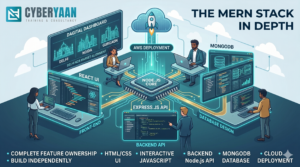
A full stack developer in Delhi NCR’s 2026 job market is expected to build complete web application features independently. This means writing the HTML and CSS that creates the user interface, writing the JavaScript that makes the interface interactive, connecting the frontend to a backend API that they also build in Node.js, designing the MongoDB database that stores the application data, and deploying the complete application to a cloud environment.
The MERN stack – MongoDB, Express.js, React.js, and Node.js – is the specific combination that dominates Delhi NCR’s full stack job market. Startups and product companies across Gurgaon, Noida, and Delhi consistently specify MERN stack in their full stack developer requirements. A full stack developer course in Delhi that teaches the complete MERN stack from HTML fundamentals through MongoDB database design is the most directly aligned training pathway for this specific market.
Step 1 – Build Your HTML and CSS Foundation (Weeks 1 to 3)
Every full stack developer’s journey starts at the same place regardless of how experienced they eventually become. HTML is the structure of every web page that has ever existed. CSS is what makes it look like anything other than a wall of text. These are not optional preludes to the real learning – they are the foundation that every subsequent skill depends on.
What to focus on in HTML:
Semantic HTML5 elements – understanding why you use article, section, nav, header, and footer rather than generic div tags everywhere. Forms and form validation – because every web application requires users to input data and that data goes through HTML forms before it reaches your backend. Tables, lists, links, images, and the document structure that makes a webpage meaningful to both browsers and search engines.
What to focus on in CSS:
The box model is the single most important CSS concept to genuinely understand – every layout decision you make as a developer is a box model decision at its core. Flexbox for one-dimensional layouts and CSS Grid for two-dimensional layouts. Responsive design using media queries – because every application built in 2026 must work on mobile screens as well as desktop. CSS variables and basic animations.
The Mozilla Developer Network provides the most authoritative and comprehensive HTML and CSS reference documentation available – every full stack developer returns to MDN throughout their career, not just during learning.
By the end of week three you should be able to build a complete, responsive, multi-page website from scratch without referencing a tutorial. If you cannot do that yet, spend more time on the foundation before moving forward.
Step 2 – Master JavaScript Properly (Weeks 4 to 8)
JavaScript is the most important language in the MERN stack and the one where most beginners make the critical mistake of moving on before they genuinely understand it. Learning React before you understand JavaScript closures, asynchronous programming, and the event loop is one of the most common causes of full stack developer career failure – people who look like they can build things but cannot debug production issues or answer technical interview questions with genuine understanding.
JavaScript fundamentals that cannot be skipped:
Variables, data types, operators, and control flow are the entry point. Functions including arrow functions, default parameters, and rest parameters. Array methods – map, filter, reduce, find, and forEach – because these appear constantly in both frontend and backend development. Object destructuring and spread operators. Template literals. Promises and async/await for handling asynchronous operations – this is where JavaScript gets genuinely complex and where genuine understanding separates strong developers from those who can only follow tutorials.
The DOM manipulation layer:
Document Object Model manipulation – selecting elements, modifying content, handling events, and dynamically updating the page in response to user actions – is the bridge between static HTML pages and interactive web applications. Understanding DOM manipulation deeply makes React significantly more learnable because React is fundamentally an abstraction over manual DOM manipulation.
ES6 and modern JavaScript:
Classes, modules, destructuring, the spread operator, and the optional chaining operator are the modern JavaScript features that appear throughout professional codebases. A full stack developer course in Delhi that teaches modern ES6+ JavaScript rather than legacy patterns is preparing students for current professional codebases rather than decade-old tutorials.
Step 3 – Learn React.js for Frontend Development (Weeks 9 to 13)
React is the frontend framework that dominates Delhi NCR’s full stack developer job market. Understanding why it exists makes it significantly more learnable than approaching it as a collection of syntax to memorize.
React solves a specific problem. Building complex, interactive user interfaces with vanilla JavaScript DOM manipulation becomes unmanageable as the application grows. State changes in one part of the interface need to update multiple other parts. Managing this manually becomes exponentially complex. React introduces a component-based architecture and a virtual DOM that handles this complexity systematically.
The React concepts that matter most:
Components – both functional components and understanding why class components existed. JSX – the syntax that looks like HTML inside JavaScript and why it compiles the way it does. Props for passing data between components. State and the useState hook for managing component data that changes. The useEffect hook for handling side effects including API calls and DOM interactions. The useContext hook for sharing state across component trees without prop drilling.
React performance concepts:
React.memo for preventing unnecessary re-renders. Understanding when components re-render and why. The dependency array in useEffect and why getting it wrong causes infinite loops or stale data. These are the concepts that technical interviews test for at every mid-level and above developer screening.
React Router for navigation:
Multi-page applications built in React use React Router to handle navigation without full page reloads. Understanding client-side routing, dynamic routes, and nested routes is essential for building real applications rather than single-page demos.
The React official documentation was completely rewritten in 2023 with interactive examples and is now genuinely excellent for self-directed learning alongside structured training.
Step 4 – Build the Backend With Node.js and Express.js (Weeks 14 to 18)
This is where the full stack part of full stack developer becomes real. Node.js brings JavaScript to the server side – allowing you to write both frontend and backend code in the same language, which is one of the primary reasons the MERN stack became the dominant full stack combination in India’s startup ecosystem.
Node.js fundamentals:
Understanding the Node.js event loop and why it makes Node performant for I/O-intensive applications. The module system – CommonJS require and ES Module import. The built-in modules – fs for file system operations, path for file path handling, http for creating basic HTTP servers. npm – the Node Package Manager – and how to manage project dependencies.
Express.js for API development:
Express.js is the minimal web framework that turns Node.js into a practical REST API server. Understanding middleware – the functions that process requests before they reach your route handlers – is the most important Express.js concept. Route handlers for GET, POST, PUT, PATCH, and DELETE requests. Request and response objects. Error handling middleware. CORS configuration for allowing your React frontend to communicate with your Express backend.
REST API design:
Building a well-designed REST API is a skill distinct from just getting Express routes to work. Understanding resource-based URL design, appropriate HTTP status codes, consistent response formats, and API versioning is what separates APIs that professional developers can work with from APIs that technically function but create maintenance problems.
Authentication implementation using JSON Web Tokens is the most important backend skill for full stack developers – every real application requires users to log in and every request from a logged-in user must be verified. Understanding JWT generation, verification, and the common security mistakes around JWT implementation is directly tested in technical interviews for full stack developer course in Delhi graduates targeting roles at security-conscious organizations.
Step 5 – Master MongoDB for Database Management (Weeks 19 to 22)
MongoDB is the database layer of the MERN stack and the one where AI-generated code most frequently produces functionally correct but performance-disastrous implementations. Understanding MongoDB deeply – not just how to perform basic CRUD operations but how to design schemas and write efficient queries – is what separates full stack developers who can build production applications from those who can build demos.
MongoDB fundamentals:
Documents and collections – how MongoDB organizes data and how this differs from relational database tables. CRUD operations – create, read, update, and delete – using both the MongoDB shell and the Mongoose ODM. Data types and the implications of schemaless versus schema-validated approaches.
Mongoose ODM:
Mongoose provides schema validation, middleware, and a cleaner API for interacting with MongoDB from Node.js. Schema definition with data type validation, required fields, and default values. Model creation and the methods available on Mongoose models. Middleware for pre and post save operations.
MongoDB aggregation pipeline:
This is the advanced MongoDB capability that most beginners skip and then discover they needed when building real applications. The aggregation pipeline allows complex data transformations and analysis operations to happen inside MongoDB rather than in application code – producing significantly better performance for data-intensive queries. The MongoDB University provides free official courses on aggregation pipeline design that every MERN stack developer should complete.
Schema design patterns:
The N+1 query problem – where fetching a list of items and their related data produces one query per item – is one of the most commonly introduced performance issues in MongoDB applications and one that AI code assistants generate frequently. Understanding when to embed related data versus when to reference it, and how to use the $lookup aggregation operator to join collections efficiently, is the database design knowledge that production full stack applications require.
Step 6 – Build Your Portfolio Project (Weeks 23 to 26)
The portfolio project is where the complete MERN stack comes together and where the gap between candidates who just completed a full stack developer course in Delhi becomes visible to hiring managers.
A portfolio project that impresses Delhi NCR’s technical interviewers is not a to-do list application or a weather widget. It is a complete, production-quality application that demonstrates architectural decision-making, real database design, authentication implementation, responsive frontend design, and deployment to a cloud environment.
What makes a portfolio project impressive:
User authentication with JWT including registration, login, logout, and protected routes. A meaningful data model with multiple related collections and proper indexing. A React frontend with multiple pages, form validation, loading states, and error handling. An Express REST API with proper middleware, input validation, and error handling. Deployment – the application must be accessible at a real URL, not just running on localhost.
The GitHub repository matters as much as the application:
A GitHub repository with clean commit history, a detailed README explaining the architecture, the technology choices, and how to run the project locally, and clear code organization demonstrates the professional development habits that hiring managers look for. A deployed application link that actually works demonstrates that you can take a project from code to production.
Step 7 – Understand Deployment and Basic DevOps (Week 27 to 28)
Full stack developers in Delhi NCR’s current job market are increasingly expected to understand how to deploy their applications – not just build them. This does not mean becoming a dedicated DevOps engineer but understanding enough cloud and deployment tooling to take your application from your development machine to a production environment.
The practical minimum for a full stack developer seeking roles in Delhi NCR includes understanding how to deploy a Node.js application to a cloud provider, how to set environment variables securely in a production environment, how to connect a production application to a cloud-hosted MongoDB instance using MongoDB Atlas, and how to deploy a React frontend to a hosting service.
For students who want to go deeper into the infrastructure and automation side after completing a full stack developer course in Delhi, Cyberyaan’s DevOps course covers Docker, Kubernetes, Jenkins CI/CD, and Terraform as a natural career extension that significantly expands earning potential and career scope.
What the Delhi NCR Full Stack Job Market Looks Like in 2026
Understanding the specific hiring landscape helps set accurate expectations and helps you target your learning toward the skills that Delhi NCR employers specifically test for.
Entry-level full stack developer roles in Delhi NCR for candidates with genuine MERN stack proficiency and a strong portfolio project start between Rs 3.5 to Rs 6 LPA. Candidates who additionally demonstrate React performance optimization skills, MongoDB aggregation knowledge, JWT authentication implementation, and basic deployment capability consistently receive offers at the higher end of this range.
With 1 to 3 years of experience this grows to Rs 7 to Rs 15 LPA as developers build depth in specific areas like performance optimization, system design, or security-aware development. Senior full stack developers with strong architectural skills reach Rs 15 to Rs 30 LPA in Delhi NCR’s product company and startup ecosystem.
The organizations actively hiring full stack developers from the Delhi NCR market include Gurgaon’s startup corridor around Cyber Hub and DLF Cyber City, Noida’s product company ecosystem in Sectors 62 and 63, and the broader IT services and digital agency market across Delhi.
NASSCOM consistently identifies full stack development as one of the most difficult technical roles to fill in India’s technology market – confirming that the supply shortage creating this opportunity is structural rather than temporary.
How Cyberyaan’s Full Stack Developer Course in Delhi Delivers This Roadmap
The roadmap described in this blog – from HTML fundamentals through MERN stack development to portfolio project and deployment – is exactly what Cyberyaan’s full stack developer course in Delhi delivers in a structured, sequenced, hands-on program.
Every module in Cyberyaan’s full stack developer course in Delhi builds directly on the previous one. HTML and CSS first. Modern JavaScript including ES6 and async programming next. React with hooks and performance optimization. Node.js and Express for backend API development. MongoDB with Mongoose and aggregation. Real-world project development throughout every stage – not just a capstone project at the end but applied building at every module.
The trainers are practicing developers who have built production applications in the MERN stack – not academics teaching from documentation. The lab environments are real development environments, not sandboxed simulations. And the placement support connects graduates specifically with the Delhi NCR employers who are actively looking for MERN stack developers.
For students who want to explore the complete curriculum and batch details: full stack developer course in Delhi
Frequently Asked Questions
Q1: How long does it take to become a full stack developer in Delhi?
A: A structured, intensive full stack developer course in Delhi covering the complete MERN stack from HTML through MongoDB with hands-on project work takes approximately 6 to 8 months to complete to a job-ready standard. Self-directed learning without structured guidance typically takes significantly longer because the integration complexity of the full stack only becomes visible through connected, end-to-end project practice rather than isolated tool tutorials.
Q2: Can a non-programmer from Delhi become a full stack developer?
A: Yes. HTML and CSS require no prior programming experience – they are markup languages that are learnable by anyone with basic computer literacy. JavaScript is the first actual programming language in the MERN stack roadmap and while it requires more effort from non-programmers, the structured progression from fundamentals through advanced concepts in a quality full stack developer course in Delhi makes it consistently achievable for students from non-technical backgrounds.
Q3: Is MERN stack the right choice for Delhi NCR’s job market in 2026?
A: Yes. MERN stack – MongoDB, Express.js, React.js, and Node.js – is the most consistently requested full stack technology combination in Delhi NCR’s startup, product company, and digital agency job postings. React is the dominant frontend framework in India’s technology market. Node.js is the backend of choice for high-growth startups. MongoDB is the most widely used NoSQL database in MERN applications. Learning MERN stack through a structured full stack developer course in Delhi directly targets the skills that Delhi NCR employers are hiring for.
Q4: What salary can I expect after a full stack developer course in Delhi?
A: Entry-level full stack developer roles in Delhi NCR for candidates with genuine MERN stack skills and a strong project portfolio start between Rs 3.5 to Rs 6 LPA. Candidates who demonstrate React performance skills, MongoDB aggregation knowledge, and basic deployment capability receive offers at the higher end of this range. With 1 to 3 years of experience this grows to Rs 7 to Rs 15 LPA. Senior full stack developers with architectural skills reach Rs 15 to Rs 30 LPA in Delhi NCR’s product company ecosystem.
Q5: Should I learn TypeScript as part of a full stack developer course in Delhi?
A: TypeScript is increasingly expected in production MERN stack applications at larger organizations. However it is best learned after JavaScript fundamentals are solid rather than alongside them. The most efficient approach is to complete JavaScript and React training first, build your initial portfolio project in JavaScript, and then learn TypeScript as an enhancement that you apply to existing projects. Many full stack developer course in Delhi programs introduce TypeScript in this sequence rather than from the beginning.
Q6: Where can I find the best full stack developer course in Delhi?
A: Cyberyaan’s full stack developer course in Delhi covers the complete MERN stack across seven focused modules – HTML, CSS, JavaScript, React.js, Node.js, Express.js, and MongoDB – with hands-on project development throughout and placement support connecting graduates with Delhi NCR employers actively hiring full stack developers. Complete details at: https://cyberyaan.com/Diploma/full-stack-developer-course-in-delhi.html