
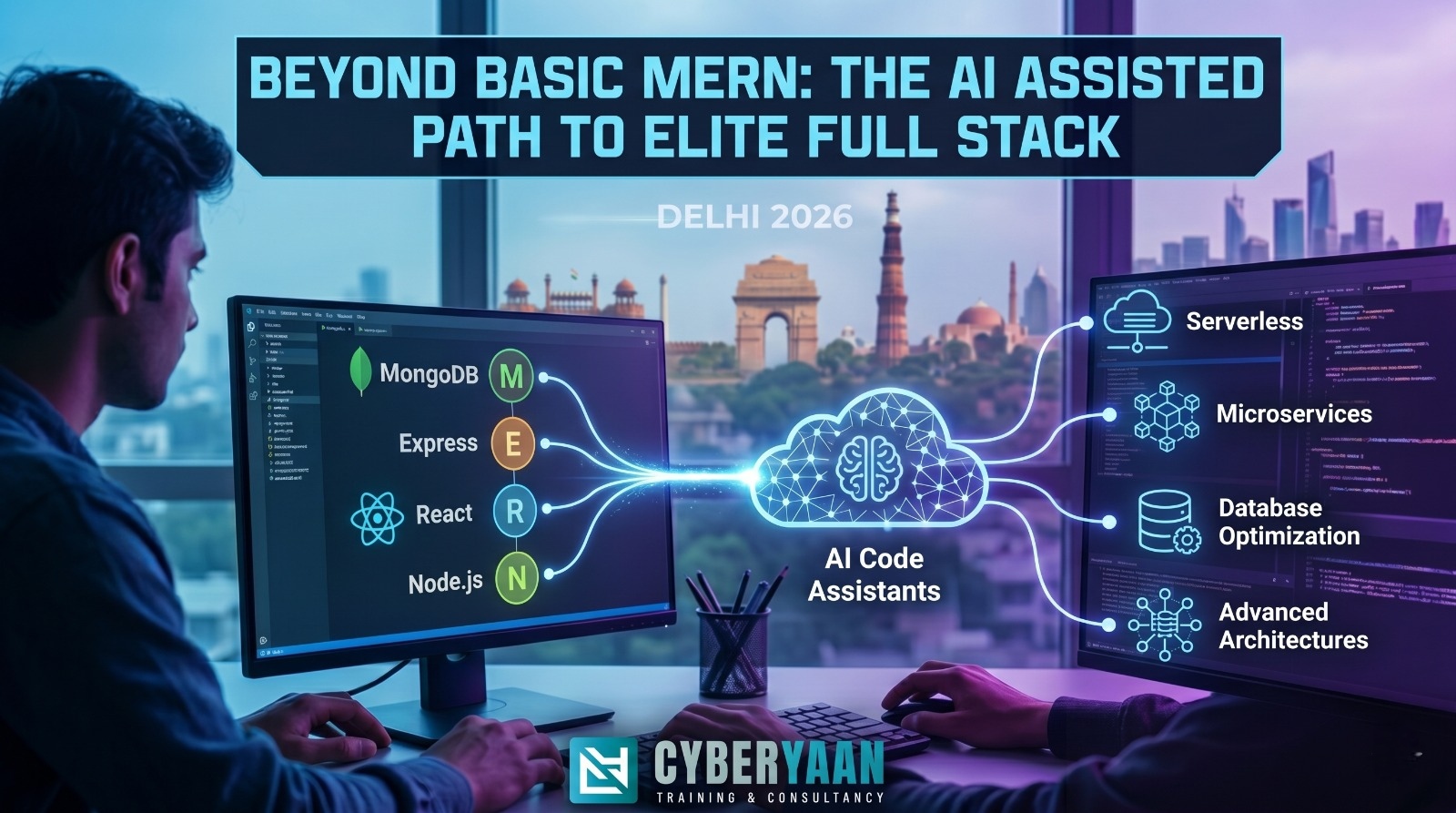
The question arrives in every career counseling session, every college WhatsApp group, and every LinkedIn comment thread about technology careers in 2026. Will AI replace full-stack developers? Should I still bother completing a full stack developer course in Delhi when GitHub Copilot can write React components in seconds?
The answer is not what the anxiety suggests. AI is not replacing full-stack developers in Delhi NCR’s job market. It is replacing a specific kind of full-stack developer – the one who writes boilerplate code manually, searches Stack Overflow for syntax patterns, and spends three hours building a component that Copilot can scaffold in three minutes.
The developer who understands how AI code assistants work, knows when to trust them and when to question them, and can use them to build faster, better, and more securely than a developer without AI skills – that person is more valuable in 2026 than at any previous point in the history of software development.
This blog explains what that means practically for every student considering a full stack developer course in Delhi right now.
What Skills Do Modern Full Stack Developers Need in 2026?
This is the question that Delhi NCR hiring managers are asking when they review developer resumes in 2026 – and the answer has shifted significantly from what it was even two years ago.
AI-Assisted Development Proficiency
The ability to use AI code assistants including GitHub Copilot, Cursor, and Claude as accelerators rather than replacements. This means knowing how to write effective prompts that produce usable code, how to review AI-generated output for security vulnerabilities and logical errors, how to iterate on AI suggestions using context-aware prompting, and when to discard AI output entirely and write manually.
Prompt Engineering for Code Optimization
The specific skill of writing structured, context-rich prompts that produce high-quality, production-ready code suggestions rather than generic boilerplate. Prompt engineering for developers is not the same as prompt engineering for content generation – it requires understanding of the codebase context, the specific function requirements, the security constraints, and the performance expectations that a good AI suggestion must satisfy simultaneously.
Microservices Architecture Understanding
Modern web applications in Delhi NCR’s enterprise market are increasingly built on microservices rather than monolithic architectures. A full stack developer course in Delhi that only teaches monolithic MERN stack architecture is preparing students for yesterday’s deployment model. Understanding how to decompose applications into services, how services communicate via REST APIs and message queues, and how Node.js and Express.js function in a microservices context is increasingly a baseline expectation.
AI-Assisted Deployment and DevOps Integration
The boundary between full-stack development and DevOps is blurring. Modern full-stack developers are expected to understand CI/CD pipelines, containerization with Docker, and basic cloud deployment on AWS or Azure. AI tools have made this boundary more permeable – GitHub Copilot and similar tools can generate Dockerfile configurations, deployment scripts, and basic CI/CD pipeline definitions that previously required dedicated DevOps expertise.
Performance Optimization and Database Architecture
AI tools are excellent at generating functional code but frequently produce inefficient database queries, N+1 query patterns, and suboptimal React rendering logic. The developer who can identify these performance issues in AI-generated code and optimize them is significantly more valuable than one who cannot.
The MERN Stack Is Not Obsolete – It Is the Foundation for Everything Above
Before exploring how AI is changing what a full stack developer course in Delhi must teach, it is important to address a misconception that the AI anxiety has created.
Some students are concluding that learning MERN stack fundamentals is pointless if AI can generate MERN code automatically. This conclusion is exactly backwards.
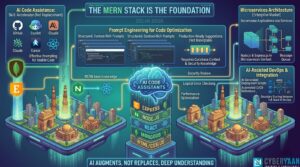
AI code assistants generate code. They do not understand the codebase. They do not know why a particular architectural decision was made six months ago. They do not understand the performance implications of a MongoDB aggregation pipeline on a dataset with ten million documents. They do not recognize when a React component’s state management pattern will cause rendering cascades under production load.
The developer who uses GitHub Copilot to scaffold a Node.js REST API endpoint in thirty seconds and then reviews, optimizes, and secures that output effectively is the developer who deeply understands Node.js, Express.js, and REST API design patterns. The developer who copies Copilot’s output without understanding it produces code that works in development and fails in production.
React’s official documentation explicitly addresses this in its guidance on AI-assisted development – noting that AI tools are most valuable to developers who already understand the underlying concepts rather than those trying to learn through AI output.
This is why the MERN stack foundation remains the essential core of any quality full stack developer course in Delhi. HTML, CSS, JavaScript, React, Node.js, Express.js, and MongoDB are not being replaced by AI. They are being augmented by AI in ways that reward deep understanding rather than surface familiarity.
How GitHub Copilot and AI Assistants Actually Work in Production Development
Understanding how AI code assistants function technically helps developers use them more effectively and recognize their limitations more accurately.
GitHub Copilot, Claude, and similar tools are large language models trained on enormous codebases. They generate code by predicting what token is most likely to follow the preceding context – they do not understand the code they generate in the way a human developer does. They have no awareness of your specific application’s architecture, your database schema, your performance requirements, or your security constraints unless you explicitly provide that context in your prompt.
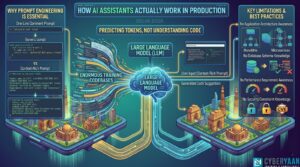
This is why prompt engineering for code optimization is a genuine skill rather than a marketing concept. A developer who provides Copilot with the full function signature, the expected input and output types, the performance constraints, the security requirements, and the existing code patterns in the surrounding codebase consistently receives significantly better suggestions than one who provides a one-line comment and accepts the first output.
The GitHub documentation on Copilot best practices specifically identifies context richness as the primary determinant of suggestion quality – confirming that the developer’s ability to provide structured context is the skill that determines whether AI assistance is genuinely productive or merely plausible-looking.
For students completing a full stack developer course in Delhi, this means learning to work with AI tools is a learnable technical skill like any other – not a vague “use AI to help you” concept but a specific set of practices around context provision, output review, and iterative refinement.
The Security Review Skill That AI Makes Non-Negotiable
Here is a development reality that most AI enthusiasm overlooks. AI code assistants frequently generate insecure code. Not maliciously – they generate code that matches patterns from their training data, and a significant proportion of publicly available code on which they were trained contains security vulnerabilities.
SQL injection patterns in database query construction. Missing input validation in Express.js route handlers. Insecure JWT implementation in authentication middleware. Overly permissive CORS configuration. Hardcoded credentials in environment configuration examples. These are all vulnerability patterns that appear regularly in AI-generated code and that a developer without security awareness will include in their application without recognizing the risk.
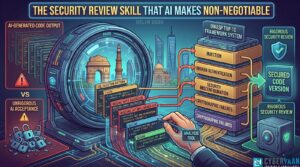
The OWASP Top 10 – the authoritative list of the most critical web application security vulnerabilities – provides the framework for reviewing AI-generated code systematically. A developer who understands injection attacks, broken authentication, security misconfiguration, and cryptographic failures can review Copilot output against this framework and catch the vulnerabilities that AI introduces before they reach production.
This security review capability is becoming a distinguishing skill in Delhi NCR’s full-stack developer hiring market. Organizations that have adopted AI-assisted development workflows are discovering that code quality and security issues are increasing rather than decreasing when developers accept AI output without rigorous review. The full-stack developers who can provide that review are becoming genuinely valuable in ways that pure coding speed never was.
A comprehensive full stack developer course in Delhi should incorporate OWASP Top 10 awareness as part of its curriculum – not as a separate security module but as an integrated lens applied to every code review activity throughout the program.
MongoDB Performance Optimization – Where AI Falls Short and Human Expertise Wins
MongoDB is the database layer of the MERN stack and it is the layer where AI assistance is most likely to produce functionally correct but performance-catastrophic code – particularly for applications with significant data volumes.
The N+1 query problem is one of the most common performance anti-patterns in MongoDB applications and one of the most frequently generated by AI assistants. When a developer asks Copilot to generate code that retrieves a list of blog posts with their author information, the most common AI-generated pattern involves a separate database query for each post’s author – producing one query for the list plus one query per post. An application with 1000 posts generates 1001 database queries where a properly structured aggregation pipeline generates one.
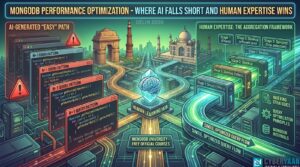
Understanding MongoDB’s aggregation framework, the $lookup operator, indexing strategies, and query optimization principles is the knowledge that separates a developer who can catch this pattern in AI-generated code from one who deploys it to production. This understanding only comes from structured learning of MongoDB internals – exactly the kind of depth that a quality full stack developer course in Delhi develops.
MongoDB University provides free official courses on aggregation pipeline optimization and performance tuning – resources that every MERN stack developer should work through regardless of how much AI assistance they use in their development workflow.
React in the Age of AI – What Still Requires Human Understanding
React’s component architecture, state management patterns, and rendering optimization are areas where AI assistance is simultaneously most useful and most likely to produce subtle issues that only manifest under production conditions.
Copilot is excellent at generating React component boilerplate – JSX structure, basic prop definitions, simple event handlers. It is significantly less reliable when it comes to useEffect dependency arrays, React.memo optimization decisions, context API architecture for complex state, and the rendering performance implications of different state update patterns.
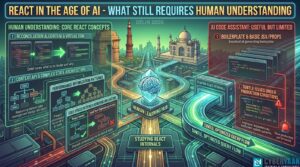
The developer who understands React’s reconciliation algorithm – how React determines what to re-render and why – can look at AI-generated component code and immediately identify patterns that will cause unnecessary re-renders at scale. This is not theoretical knowledge – it directly determines whether an application performs acceptably or becomes unusably slow as the user base grows.
This understanding comes from studying React’s internals, not from using React through AI assistance. A full stack developer course in Delhi that teaches React deeply – hooks, context, performance optimization patterns, and the reasoning behind React’s design decisions – produces developers who can use AI assistance effectively rather than developers who depend on it without understanding what it produces.
What Delhi NCR Employers Are Actually Looking For in 2026
The hiring managers at Delhi NCR’s technology companies – the startups in Gurgaon, the product companies in Noida, the IT services firms across the corridor – are remarkably consistent in what they report looking for in full-stack developer candidates in 2026.
They are not looking for developers who can write boilerplate CRUD applications without AI assistance. That is a skill that is genuinely becoming commoditized. They are looking for developers who demonstrate clear thinking about architecture decisions, who can review code – their own or AI-generated – for quality, performance, and security issues, who understand the complete stack deeply enough to debug production issues across the frontend, backend, and database layers simultaneously, and who can explain their technical decisions clearly in both code reviews and stakeholder conversations.
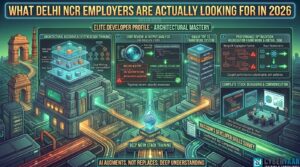
Completing a comprehensive full stack developer course in Delhi that develops this depth of understanding – not just syntax familiarity but genuine architectural comprehension – is what produces the developer profile that Delhi NCR employers are consistently struggling to find.
NASSCOM’s developer skills survey confirms that problem-solving ability, code review skills, and system design thinking are the top three competencies that Indian technology employers report as hardest to find in junior developer candidates. These are precisely the skills that deep MERN stack training develops and that AI assistance, used without that foundation, systematically fails to develop.
The Practical Curriculum Implications for a Full Stack Developer Course in Delhi
Given everything described above, what should a quality full stack developer course in Delhi actually include in 2026?
The core MERN stack curriculum remains essential and unchanged – HTML5 and CSS3 with responsive design, JavaScript ES6 and async programming, React with hooks and performance optimization, Node.js with event-driven architecture, Express.js with middleware and API design patterns, and MongoDB with aggregation and indexing.
On top of this foundation, a genuinely current program should incorporate practical AI tool usage throughout the curriculum – not as a separate module but as an integrated workflow. Students should learn to use Copilot and similar tools to accelerate their work while simultaneously developing the review and optimization skills that determine whether AI assistance is an asset or a liability.
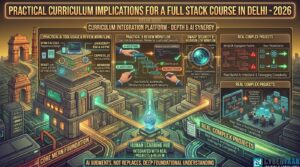
Security-aware development practices should be woven through every module rather than treated as an optional addition. Understanding OWASP vulnerabilities, reviewing code for injection risks, implementing proper authentication patterns, and validating API inputs are skills that every full-stack developer needs regardless of how much AI assistance they use.
Real project development – not tutorial projects but genuinely complex applications that require architectural decisions, performance optimization, and debugging across the full stack – is the only environment where these integrated skills develop to the level that technical interviews reveal.
Cyberyaan’s full stack developer course in Delhi covers the complete MERN stack across seven focused modules alongside hands-on project development that builds the architectural understanding and debugging depth that Delhi NCR employers are looking for in 2026.
Frequently Asked Questions
Q1: Will AI replace full stack developers in Delhi NCR?
A: No – but AI is changing what skills make a full stack developer valuable. AI tools are replacing the manual writing of boilerplate code. They are creating increasing demand for developers who can review AI-generated output for quality, security, and performance issues. Completing a full stack developer course in Delhi that develops deep MERN stack understanding positions you for this higher-value role rather than the commoditized boilerplate-writing role that AI is genuinely replacing.
Q2: Should I learn AI tools as part of my full stack developer course in Delhi?
A: Yes, but in the right order. Learn the MERN stack fundamentals first – HTML, CSS, JavaScript, React, Node.js, Express.js, and MongoDB. Once you understand these deeply enough to recognize good code from bad code, integrating AI code assistants like GitHub Copilot into your workflow accelerates development without compromising your ability to review and optimize what the AI produces. Skipping the fundamentals and relying on AI from the start produces fragile skills that collapse in technical interviews.
Q3: What is prompt engineering for developers and why does it matter?
A: Prompt engineering for developers is the practice of writing structured, context-rich inputs to AI code assistants that produce high-quality, production-ready code suggestions. It involves providing function signatures, input and output type definitions, performance constraints, security requirements, and surrounding code context. Developers who provide rich context consistently receive better AI suggestions than those who provide minimal context. It is a learnable skill that compounds in value as AI tools improve.
Q4: How important is MongoDB optimization for a full stack developer in 2026?
A: Very important – and increasingly so as AI tools generate MongoDB code that is functionally correct but performance-inefficient. Understanding aggregation pipelines, the N+1 query problem, indexing strategies, and query optimization principles is what allows a developer to catch and fix AI-generated performance issues before they reach production. MongoDB performance knowledge is a genuine differentiator in Delhi NCR full-stack developer technical interviews.
Q5: Does Cyberyaan’s full stack developer course in Delhi include project work?
A: Yes. Hands-on project development is built into every module of Cyberyaan’s full stack developer course in Delhi. By the end of the program, students have a portfolio of working MERN stack applications that demonstrate architectural decision-making, API design, database management, and full-stack debugging capability – exactly the portfolio evidence that Delhi NCR hiring managers look for in technical screening. More details at https://cyberyaan.com/Diploma/mern-stack-diploma-in-delhi.html
Q6: What is the salary for a full stack developer in Delhi NCR in 2026?
A: Entry-level full stack developer roles in Delhi NCR for graduates with hands-on MERN stack project experience start between Rs 3.5 to Rs 6 LPA. Developers with AI tool proficiency, security awareness, and performance optimization skills command Rs 5 to Rs 8 LPA at the entry level. With 1 to 3 years of experience this grows to Rs 8 to Rs 15 LPA, with senior full-stack developers and technical leads earning Rs 15 to Rs 30 LPA across Delhi NCR’s startup, product, and enterprise technology sectors.