
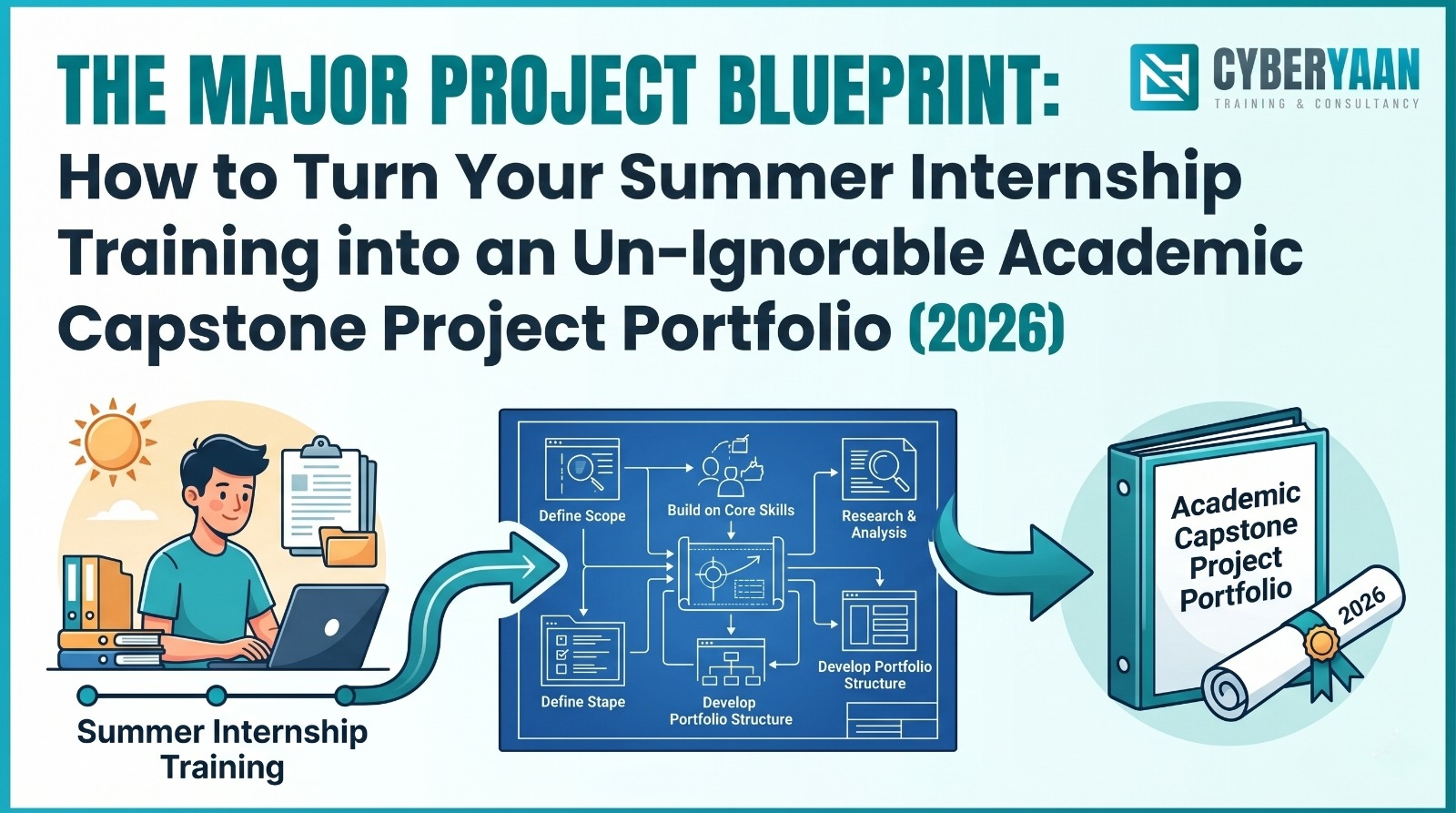
Every year, there are countless pre-final or final year students studying in universities of Delhi like GGSIPU, DU, AKTU-affiliated colleges, along with many other colleges, who have to deal with the same double whammy at the same time. One side is the task of submitting a college project: something practical and industrially based that satisfies all the academic parameters. The second side is that of preparing for their career by creating an impressive security portfolio in the eyes of Delhi NCR’s cybersecurity employers.
Most students treat these as separate problems requiring separate solutions. They complete a summer internship training for the career side and then scramble to produce something academic-looking for the college project side – often producing two mediocre outputs instead of one excellent one.
The students who understand what this blog is about do something fundamentally different. They execute a single, structured engagement – a capstone security audit project – during their summer internship training that simultaneously satisfies every academic evaluation criterion their college requires AND produces a client-ready professional portfolio deliverable that impresses cybersecurity hiring managers.
This blog is the blueprint for doing exactly that.
Understanding What Your College Actually Requires
Before explaining how summer internship training maps to academic project requirements, it is worth being precise about what most Delhi university project evaluation committees actually assess – because the requirements are more achievable than most students assume.
GGSIPU-affiliated colleges typically require industrial training reports and major projects that demonstrate: a clearly defined problem statement, a structured methodology for addressing it, documented technical implementation, results and analysis, and a conclusion with recommendations. The evaluation committee is assessing whether the student can approach a real-world technical problem systematically and communicate their work professionally in writing.
DU colleges with BCA and BSc Computer Science programs have similar requirements – a project that shows practical application of theoretical knowledge, documented in a format that demonstrates academic rigor.
AKTU-affiliated engineering colleges require major project reports that follow a structured format covering introduction and problem statement, literature review, methodology, implementation, testing and results, and conclusions.
What all three have in common is this: they are not assessing whether you built something novel or discovered something original. They are assessing whether you can execute a structured technical process, document it professionally, and present it coherently.
A security audit – specifically a vulnerability assessment and basic penetration test of an authorized target environment – satisfies every one of these criteria naturally. The problem statement is the security posture of the target. The methodology is the penetration testing methodology covered in your summer internship training. The implementation is the hands-on assessment work. The results are the vulnerability findings. The analysis is the severity assessment and risk prioritization. The conclusions and recommendations are the remediation guidance.
The academic project and the professional portfolio are the same document, approached with the right framework.
Why a Capstone Security Audit Is the Perfect Academic Project
The term capstone project originally referred to the final stone placed at the top of an arch – the piece that locks everything else in place and makes the entire structure stable. In academic terms, a capstone project is meant to demonstrate the synthesis of everything you have learned, applied to a real problem.
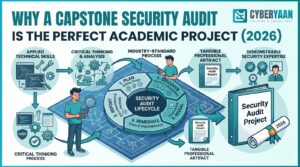
A security audit during your summer internship training is a genuine capstone in this sense – it requires you to apply networking knowledge to understand the target environment, Linux proficiency to operate your assessment tools, Python scripting to automate enumeration tasks, web application security knowledge to test HTTP-based services, and professional communication skills to document and present findings.
No other project type available to cybersecurity and computer science students simultaneously exercises such a broad range of technical competencies. This breadth is exactly what makes it compelling to both academic evaluators and professional hiring managers.
The Enterprise Capstone Security Audit – What It Actually Looks Like
The Enterprise Capstone Security Audit is a structured security assessment conducted against an authorized target environment – typically a practice lab environment set up specifically for the purpose, a small business that has provided written authorization, or a designated vulnerable-by-design practice system.
The word Enterprise in the title is not just for impact. It refers to the professional standards applied to the work – the same standards that enterprise security consultants apply in paid client engagements. Documentation is structured to professional report standards. Findings are rated using CVSS severity scoring. Remediation recommendations are specific and actionable. The executive summary is written for a non-technical audience. The technical appendix is detailed enough for a developer to implement the fixes.
This professional standard is what transforms a college project into a professional portfolio piece – and it is exactly the standard that quality summer internship training programs teach students to apply.
The Cyberyaan summer internship training program in Delhi specifically develops the professional documentation skills alongside the technical assessment capabilities – recognizing that a penetration tester who cannot produce a professional report is significantly less valuable than one who can. This dual development is what makes the program’s training directly applicable to the capstone project approach described in this blog.
Phase 1 – Planning and Scoping (Week 1 of Your Summer Internship Training)
The first phase of your Enterprise Capstone Security Audit maps directly to the introduction and problem statement section of your academic project report.
Define your target environment. For a college project context, this is most practically a home lab environment built using VirtualBox and vulnerable-by-design virtual machines – Metasploitable, DVWA (Damn Vulnerable Web Application), or a basic Windows Server instance. The OWASP foundation provides free, intentionally vulnerable web applications that are specifically designed for security testing practice and are widely recognized as legitimate practice targets in academic contexts.
Document your authorization. Even in a home lab environment, documenting the authorization – a simple statement that you own and control the test environment – establishes the professional discipline of authorization documentation that real penetration testing requires.
Define your scope. What systems are in scope? What testing activities are authorized? What is the timeline? What are the deliverables? A scope document for a home lab project can be as simple as one page, but its existence transforms your project from an informal exercise into a structured professional engagement.
Define your success criteria. What constitutes a successful assessment? Finding at least one vulnerability in each of the major categories – network layer, web application layer, and authentication? Producing a complete professional report? Demonstrating the use of at least five professional tools? Define it clearly before you start.
This planning documentation becomes your project’s introduction, objectives, and methodology sections with minimal reformatting.
Phase 2 – Reconnaissance and Information Gathering (Week 1 to 2)
The reconnaissance phase of your capstone security audit directly produces the literature review and technical background content for your academic project report.
Passive reconnaissance involves researching your target environment’s technology stack, understanding the services running, and identifying potential vulnerability classes based on known CVEs for those technologies. This research component – consulting the National Vulnerability Database, reviewing OWASP vulnerability documentation, and understanding how the technologies in your target environment have been exploited historically – produces the technical background section that every academic project report requires.
Active reconnaissance using Nmap for network scanning and service enumeration produces documented findings that become your project’s initial results section – showing the attack surface of your target environment, the services discovered, and the potential entry points identified.
Document every command you run, every tool you use, and every output you receive. Screenshot everything. This documentation habit is the single most important practice to develop during your summer internship training – it is what separates a professional assessment from an undocumented exercise and what transforms your work into an auditable, defensible project report.
Phase 3 – Vulnerability Assessment (Week 2 to 3)
The vulnerability assessment phase is where the technical depth of your summer internship training directly determines the quality of your project’s implementation section.
Using tools covered in your summer training – Nmap for detailed port and service analysis, Nessus or OpenVAS for systematic vulnerability scanning, Nikto for web server analysis, and Burp Suite for web application testing – systematically identify vulnerabilities in your target environment.
For each vulnerability discovered, document: the tool and command used to discover it, the CVE identifier if one exists, the CVSS severity score from the National Vulnerability Database, a technical description of the vulnerability and why it exists, and the potential impact if exploited by a malicious actor.
This structured vulnerability documentation becomes the core of your project’s results section. A project that documents five well-researched, properly scored vulnerabilities with clear technical explanation is significantly more impressive to both academic evaluators and hiring managers than one that lists twenty superficially described findings.
Phase 4 – Exploitation and Proof of Concept (Week 3)
The exploitation phase is where many students doing self-directed projects stop because they lack the structured training to proceed safely and professionally. This is exactly where quality summer internship training makes the difference.
In a home lab environment with authorized virtual machines, exploitation using Metasploit, SQLmap, or manual exploitation techniques is both legal and educationally valuable. The key professional requirement is that every exploitation attempt is documented with: the tool and payload used, the result of the attempt (successful or unsuccessful), a screenshot of the output, and an analysis of what the successful exploitation demonstrates about the risk to the target.
Successful exploitation proof-of-concept evidence is the most compelling content in any penetration test report – academic or professional. A screenshot showing a successful SQL injection that returns database credentials, or a Metasploit session showing successful exploitation of an unpatched service, provides concrete evidence that the vulnerability is not merely theoretical but actively exploitable.
This proof-of-concept section becomes the most technically impressive part of your project report and the content that hiring managers spend the most time reviewing in your portfolio.
Phase 5 – Professional Report Writing (Week 4)
The professional report writing phase is where your summer internship training documentation skills and your academic project report converge into a single deliverable.
The professional penetration test report structure maps directly to academic project report requirements with minimal adaptation:
Executive Summary maps to Project Abstract and Introduction. A non-technical summary of what was assessed, what was found, and what is recommended. Two to three paragraphs. Written for someone who will not read the rest of the report but needs to understand the overall security posture of the assessed environment.
Scope and Methodology maps to Objectives and Research Methodology. A precise description of what was in scope, what tools and techniques were used, and what professional standards the assessment followed. Reference the OWASP Testing Guide for web application assessment and PTES – Penetration Testing Execution Standard – for overall methodology.
Findings and Vulnerability Analysis maps to Results and Analysis. Each vulnerability documented with CVE identifier, CVSS score, technical description, proof-of-concept evidence, and business impact analysis. Organized by severity – Critical findings first, then High, Medium, and Low.
Remediation Recommendations maps to Conclusions and Recommendations. Specific, actionable guidance for fixing each identified vulnerability – not generic advice but tool-specific and configuration-specific recommendations that a developer or system administrator could implement directly.
Appendices map to Technical Appendix. Full tool outputs, complete command histories, all screenshots, and supporting reference material.
This structure satisfies both academic evaluation requirements and professional report standards simultaneously – which is the entire point of the capstone approach.
Making Your Project Un-Ignorable to Academic Evaluators
The academic evaluation committees at GGSIPU, DU, and AKTU-affiliated colleges see hundreds of project reports every cycle. The vast majority are variations on the same formats – literature reviews of well-known topics, implementation of standard projects, results that demonstrate the student completed the work without necessarily demonstrating genuine understanding.
A properly executed Enterprise Capstone Security Audit report stands out for several specific reasons.
It documents real technical work rather than theoretical research. The committee member reading a report that shows an actual Nmap scan output, an actual Metasploit exploitation attempt, and an actual CVSS-scored vulnerability finding is encountering evidence of genuine technical capability rather than a summary of textbook content.
It demonstrates professional standards. A report that includes a scope document, follows OWASP and PTES methodology references, uses CVSS scoring, and produces an executive summary alongside technical appendices shows a level of professional maturity that academic projects rarely achieve.
It shows industry-relevant skills. Cybersecurity is one of the most visible and most discussed technology fields in India right now. An evaluator who sees a thorough security audit project immediately recognizes its relevance to current industry needs.
It is defensible. When the evaluator asks technical questions during the viva or presentation, a student who actually executed the assessment can answer from direct experience rather than from memory of what they read or watched.
Making Your Project Un-Ignorable to Hiring Managers
The same document that impresses your academic evaluator serves as the centerpiece of your professional portfolio – with one important difference in presentation.
For your professional portfolio, the project is presented on GitHub with the full technical documentation, tool outputs, and screenshots organized clearly. The executive summary becomes a LinkedIn post summarizing your findings and methodology. The vulnerability findings become individual portfolio pieces that demonstrate specific technical capabilities – SQL injection identification, Nmap proficiency, Metasploit usage, or CVSS scoring ability.
A hiring manager reviewing your resume who follows a GitHub link and finds a complete, professionally structured penetration test report is encountering direct evidence of your capability. The question they are implicitly asking is “can this candidate do the work on day one?” – and a complete capstone security audit project answers that question more convincingly than any academic transcript or certification credential alone.
The Summer Training Timeline That Makes This Possible
Cyberyaan’s summer internship training is structured across 45 days – which is exactly the right timeline to execute the Enterprise Capstone Security Audit described in this blog alongside the formal training curriculum.
The structured training provides the tool proficiency and methodology framework. The capstone project provides the application context that converts that training into documented professional work. Running both simultaneously is not just efficient – it is genuinely synergistic, because the training reinforces the project and the project reinforces the training in ways that accelerate both.
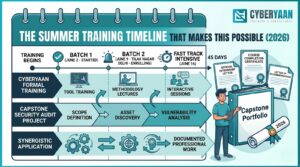
Students completing Cyberyaan’s summer internship training program also receive an official internship letter, a course completion certificate, and a Letter of Recommendation – credentials that add institutional credibility to the capstone project portfolio and strengthen both the academic submission and the professional job application.
The batch starting June 2, 2026 has already begun. The batch starting June 9 at the Tilak Nagar Delhi campus is still accepting enrollments. The fast track intensive batch starting June 16 compresses the same curriculum into a more intensive daily schedule for students with tighter timelines.
The Academic Checklist
Before submitting your capstone project report to your college evaluation committee, verify that it contains every element that academic evaluators typically require:
Certificate page signed by your project guide confirming the work was done under supervision. Acknowledgements thanking your training institute and any mentors. Abstract summarizing the complete project in 300 to 500 words. Table of contents with page numbers. Introduction with clear problem statement and objectives. Literature review covering penetration testing methodology, OWASP standards, and CVSS scoring. Methodology chapter describing your assessment approach and tool selection rationale. Implementation chapter with complete technical documentation of your assessment activities. Results and analysis chapter with all vulnerability findings, CVSS scores, and proof-of-concept evidence. Conclusions and recommendations chapter with specific remediation guidance. References following your institution’s required citation format. Appendices with complete tool outputs and supporting material.
A capstone security audit project documented to professional penetration test standards naturally contains all of these elements – which is why the approach works so consistently for academic submissions.
Conclusion
The students who will look back on this summer as the most professionally productive period of their academic career are not the ones who treated their college project requirement and their career portfolio as separate problems. They are the ones who recognized that a properly executed summer internship training capstone security audit is simultaneously the most impressive academic project they can submit and the most compelling professional portfolio piece they can build.
The blueprint is clear. The tools are available. The training framework is structured. The academic requirements are achievable. The professional portfolio value is genuine and demonstrable.
The only remaining question is whether you will use this summer to build something that serves both purposes at once – or spend it scrambling separately for academic credit on one side and career preparation on the other.
Cyberyaan’s summer internship training program gives you the methodology, the lab environment, the mentorship, the internship letter, the course completion certificate, and the Letter of Recommendation that makes the capstone approach possible. The rest is execution.