
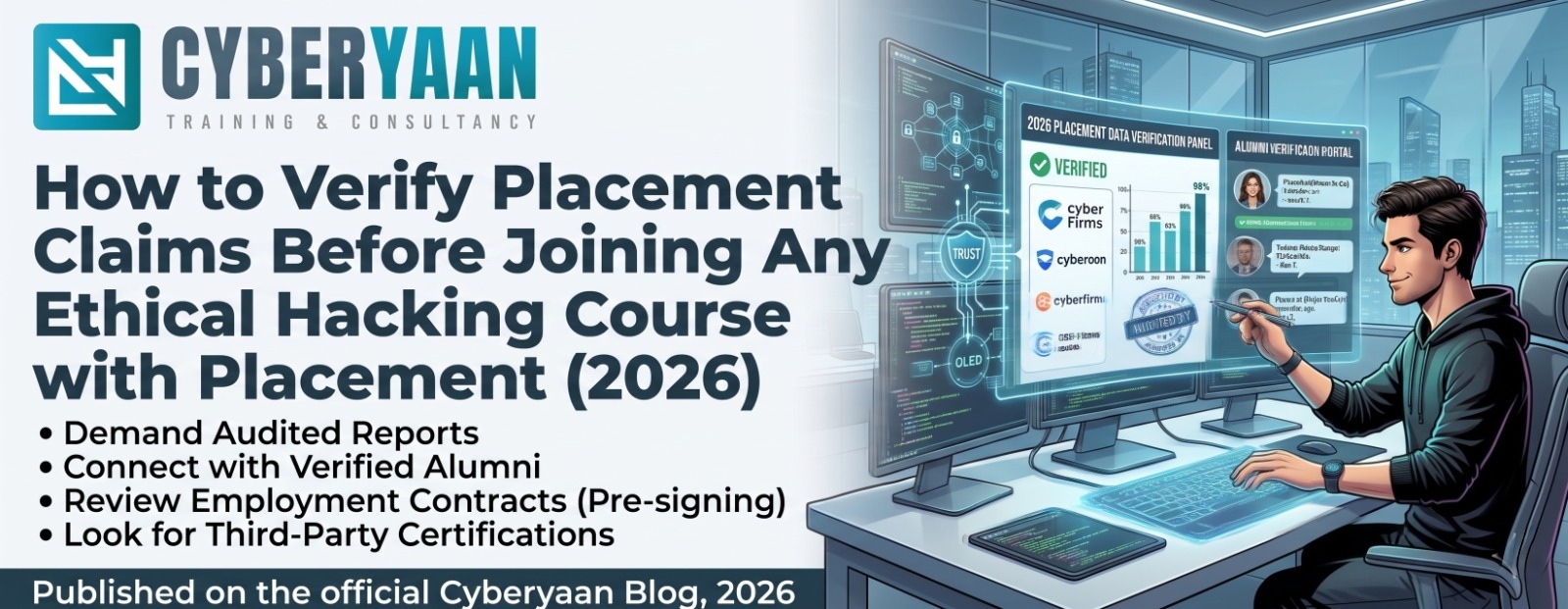
Whether you are scrolling through Instagram or walking past the billboards in Janakpuri or Laxmi Nagar, you have seen the promise: “100% Placement Guarantee or Your Money Back!” It sounds like the perfect safety net, doesn’t it? In a world where the job market feels increasingly unstable, the idea of a guaranteed paycheck at the end of a training program is incredibly tempting.
However, as someone working in the heart of the cybersecurity training industry in 2026, I have to be honest with you. Not all “placement” claims are created equal. In fact, some are outright myths designed to fill seats in a classroom. If you are looking for an ethical hacking course with placement, you need to act like a digital forensic investigator before you swipe your card.
You aren’t just buying a course; you are investing your time and your career’s foundation. Here is exactly how to strip away the marketing fluff and verify if an institute can actually get you hired.
The Difference Between “Placement Assistance” and “Placement Guarantee”
Before we dive into the verification process, let’s clear up the language. Most institutes use these two terms interchangeably, but they mean very different things in a legal and practical sense.

Placement Assistance usually means the institute will help you build a resume, conduct a few mock interviews, and send you links to job openings they find on LinkedIn or Naukri. There is no promise that an employer will actually talk to you.
Placement Guarantee (or Job Guarantee) often implies a contractual obligation. However, these usually come with “Terms and Conditions” so thick that most students never qualify for the guarantee. For example, you might be required to have 100% attendance, score over 90% in every mock test, and clear three internal rounds before they even send your resume out.
When searching for an ethical hacking course with placement, your goal should be to find an institute that offers Placement Transparency.
Step 1: The LinkedIn “Deep Dive”
This is the most effective way to verify any claim. If an institute says they placed 50 students last month, at least 40 of them should be on LinkedIn.
The Process:
-
Go to LinkedIn and search for the institute’s name (e.g., Cyberyaan).
-
Click on the “People” tab.
-
Look for students who have graduated in the last 6–12 months.
-
The Secret Move: Don’t just look at their profiles. Send a polite, short DM to 3–5 alumni. Ask them: “Hey, I’m thinking of joining the ethical hacking course with placement at X Institute. Did the placement cell actually set up interviews for you, or were you on your own?”
Real students will almost always give you the “unfiltered” truth. If an institute is blocking you from talking to alumni, consider that a massive red flag.
Step 2: Request the “Placement Log” (Not Just Logos)
Walk into any training center in Delhi, and you will see a wall of logos: Google, Microsoft, Amazon, Cisco. These logos are often misleading. They often represent where the instructors used to work, or where a student from five years ago got a job.
Instead of looking at logos, ask to see the Placement Log of the current year. A transparent institute will show you a list (with names blurred for privacy if necessary) of which student got placed in which company, on what date, and at what salary package.
If they claim to be a top ethical hacking course with placement, they should be proud to show you their recent track record. According to the NASSCOM Cybersecurity Report, the demand for security professionals is at an all-time high, so a good institute should have no trouble showing you a steady stream of successful hires.
Step 3: Verify the “Hiring Partners”
Many institutes claim to have “200+ Hiring Partners.” This sounds impressive, but what does it actually mean? Often, it just means they once sent an email to a HR manager at that company.
To verify this, check if the institute has ever hosted Campus Placement Drives. Look for photos or videos of HR teams from actual companies visiting the campus. If all their “placements” happen off-campus via email, they might not have a formal tie-up at all.
Step 4: The Quality of the Training (The Root of Placement)
You cannot be placed if you aren’t skilled. It sounds simple, but many students forget this. An ethical hacking course with placement is only as good as its lab work.
Ask the counselor: “Can I see your lab infrastructure?” In 2026, a “lab” isn’t just a room with computers. It should be a simulated environment where you can practice:
-
VAPT (Vulnerability Assessment and Penetration Testing): Real-world testing on simulated corporate networks.
-
SOC (Security Operations Center) Monitoring: Using tools like Splunk or IBM QRadar.
-
Cloud Security: Hands-on experience with AWS Security or Azure.
If the training is 100% theoretical or based on outdated YouTube videos, no amount of “placement assistance” will save you in a technical interview. Companies like CrowdStrike or Palo Alto Networks hire people who can solve problems, not people who have memorized definitions.
Step 5: Check the “Instructor-to-Placement” Ratio
Who is teaching you? If the instructor has never worked in the industry, they cannot guide you on how to get into the industry.
Verify the instructors’ LinkedIn profiles as well. Have they worked as Penetration Testers? Do they hold recognized certifications like OSCP (Offensive Security Certified Professional)? An instructor with a strong professional network is often a better “placement officer” than the actual placement department, because they can recommend you directly to their former colleagues.
Step 6: The “Salary Package” Audit
If an institute promises a starting salary of ₹12 LPA for a 3-month course with no prior experience, they are likely lying.
In the Indian market (especially Delhi-NCR), a realistic starting salary for a fresher who has completed a high-quality ethical hacking course with placement ranges between ₹4.5 LPA to ₹7 LPA. Claims that go significantly higher for “fresher” roles are often bait-and-switch tactics. Always check Glassdoor Salary Trends to see what actual entry-level security analysts are making in your city.
Step 7: The “Live Project” Verification
In a technical interview, the first question is usually: “What projects have you worked on?”
If your answer is “I watched a tutorial on Nmap,” you won’t get the job.
A genuine ethical hacking course with placement will require you to complete a Capsttone Project. This should involve:
-
Conducting a full security audit of a web application.
-
Writing a professional-grade VAPT report.
-
Presenting your findings to a mock “Board of Directors.”
If the institute doesn’t focus on report writing and project documentation, their placement claims are likely weak. In the professional world, the report is just as important as the hack.
Why Cyberyaan Focuses on “Job Readiness” Instead of Just “Placement”
At Cyberyaan, we have a slightly different philosophy. We believe that if we make you “un-ignorable” to recruiters, placement becomes a natural byproduct.

When you join our ethical hacking course with placement, we don’t just hand you a list of companies. We build your profile from the ground up:
-
GitHub Portfolio: We help you document your scripts and tools.
-
LinkedIn Branding: We show you how to engage with the cybersecurity community so recruiters find you.
-
Technical Rigor: Our labs are designed to be difficult. We want you to fail in the lab so you never fail in a real interview.
Red Flags to Watch Out For
-
The “Upfront” Placement Fee: If they ask for an extra ₹50,000 specifically for “placement” on top of the course fee, run.
-
The “Vague” Hiring Partners: If they say “we work with all big MNCs” but can’t name three specific people they’ve placed there recently.
-
No Technical Round: If the institute’s internal “placement” process doesn’t include a rigorous technical interview, they aren’t preparing you for the real world.
The Role of Certifications in Placement
While an ethical hacking course with placement provides the training, global certifications provide the validation. A good institute will encourage you to aim for:
-
CEH (Certified Ethical Hacker): The global baseline for security professionals.
-
CompTIA Security+: Excellent for foundational defensive knowledge.
-
Cyber Security Diploma: For a deeper, more career-oriented approach, our cyber security diploma course in Delhi is designed to provide the long-term depth that employers love.
Final Thoughts: Taking Ownership of Your Placement
At the end of the day, an institute is a bridge, not a destination. You are the one who has to walk across it. Even the best ethical hacking course with placement cannot help a student who isn’t willing to spend hours in the lab, stay up late studying new exploits, and constantly refine their craft.
Verify the claims, talk to the alumni, test the labs, and check the instructors. If the institute passes those four tests, you’ve found a partner that can truly help you launch your career.
FAQ: Frequently Asked Questions
1. Is “100% Placement” actually possible in cybersecurity?
In a literal sense, no one can guarantee what a third-party company will do. However, a “100% Placement Support” claim is possible, meaning the institute will keep providing you with interview opportunities until you are placed, provided you meet their technical criteria.
2. Can I get a job after just a 3-month ethical hacking course?
It is possible, but difficult for a total beginner. Most successful students either have a background in IT/Networking or opt for a more comprehensive program like a cyber security diploma course in Delhi which gives them the depth needed to clear tough interviews.
3. What is the most important skill for placement in 2026?
Beyond hacking skills, Cloud Security and AI-driven threat detection are the most sought-after skills by recruiters this year. Ensure your course curriculum includes these modern modules.
4. Should I pay extra for a “Job Guarantee” program?
Usually, no. You should pay for the quality of the training. If the training is excellent, the job will follow. “Job Guarantees” are often marketing hooks that include many hidden clauses.
5. How do I know if the placement photos on a website are real?
Use Google Lens or a reverse image search. If the “student” in the photo also appears on a stock photography website or another institute’s site in a different city, it’s a fake claim.
6. Does Cyberyaan provide placement for international students?
We provide placement assistance for the Indian market, specifically the Delhi-NCR, Bangalore, and Pune hubs. For international students, we focus on building a global-standard portfolio that works across borders.
7. Do I need a B.Tech degree to get placed via an ethical hacking course?
While a degree helps with some HR filters, the cybersecurity industry is increasingly “skills-first.” Many of our successfully placed students come from BCA, B.Com, or even non-technical backgrounds, provided they have mastered the technical labs.
Ready to start your journey with a team that values transparency over hype? Explore the curriculum of our ethical hacking course in Delhi and see how we prepare you for the real-world challenges of 2026.