
You’ve done your research. You’ve shortlisted a few institutes in Delhi. You’ve compared their brochures. And now you’re staring at two very different numbers — one institute quoting ₹25,000 and another quoting ₹1,20,000 — both calling it an “ethical hacking course.”
So what exactly is the difference?
The answer is almost never in the certificate. It’s almost always in what’s included — and what isn’t — inside that ethical hacking course fees structure.
Most students make the mistake of comparing fees as if they’re comparing identical products. They’re not. Two courses with very different price tags can deliver completely different outcomes — different tools, different lab access, different certification support, different placement infrastructure. And the cheaper option almost always leaves out something critical.
This blog breaks down exactly what Cyberyaan’s ethical hacking course fees include — and what you’d be paying extra for, or simply going without, at most other institutes in Delhi.
WHY ETHICAL HACKING COURSE FEES VARY SO DRAMATICALLY IN DELHI
Walk into any 10 institutes in Delhi and ask for their ethical hacking course fees. You’ll get numbers ranging from ₹15,000 to ₹1,50,000. That’s a 10x difference for what appears — on the surface — to be the same course.
The variation exists because institutes structure their offerings very differently. Some quote a base fee and then charge separately for certification exam vouchers, lab access, study materials, placement services, and repeat classes. Others — like Cyberyaan — build everything into a single, transparent fee structure so students know exactly what they’re getting from day one. Understanding this distinction is the most important thing you can do before paying any ethical hacking course fees anywhere.
Here is a breakdown of every component that goes into a complete, career-ready ethical hacking program — and how Cyberyaan handles each one.
COMPONENT 1 — THE CURRICULUM ITSELF
This seems obvious, but it’s where the first major gap appears. Many institutes charging low ethical hacking course fees are delivering a compressed, outdated curriculum. They cover basic topics — introduction to hacking, Kali Linux overview, a few scanning tools — and call it complete. The syllabus hasn’t been updated in years and doesn’t reflect what companies actually ask for in job interviews.
A complete ethical hacking curriculum in 2026 must include:
– Networking fundamentals and protocols
– Linux for cybersecurity (not just an overview — actual command-line proficiency)
– Footprinting and reconnaissance
– Scanning and enumeration (Nmap, Shodan)
– System hacking and privilege escalation
– Malware analysis and reverse engineering basics
– Web application security and OWASP Top 10
– SQL injection, XSS, and CSRF exploitation
– Wireless network security
– Active Directory attacks (Pass the Hash, Kerberoasting, BloodHound)
– API security testing
– Cloud security fundamentals (AWS/Azure)
– Mobile application security
– Digital forensics and incident response
– Penetration testing methodology and report writing
Cyberyaan’s ethical hacking course covers all of the above — across structured modules with defined learning outcomes for each. This is not a trimmed-down course padded with filler content. Every module exists because it appears in real job descriptions from Delhi NCR employers. Most institutes that advertise low ethical hacking course fees cover roughly half this list. The missing modules are the ones that get asked about in interviews.
COMPONENT 2 — LAB ACCESS (THE MOST COMMONLY HIDDEN COST)
This is where the biggest hidden cost in ethical hacking course fees exists — and most students don’t find out until after they’ve enrolled.
Ethical hacking cannot be learned through theory alone. You need to run Nmap scans. You need to fire Metasploit at a vulnerable machine. You need to intercept web traffic with Burp Suite. You need to practice privilege escalation on a Linux system. None of this is possible without a dedicated lab environment.
Many institutes that quote attractive ethical hacking course fees upfront do not include proper lab access in that price. Students discover — after paying — that lab sessions cost extra per hour, or that the “lab” is simply a shared computer with a few tools installed, or that lab time is available for only a few weeks of the course.
At Cyberyaan, live virtual lab access is included in the course fees — not charged separately. Students work in isolated virtual environments throughout the entire duration of the program. Every module has corresponding hands-on lab exercises. The lab isn’t an add-on. It’s the foundation of how the course is taught.
This single component — unlimited lab access for the full course duration — is something most competing institutes in Delhi either charge extra for or simply don’t offer at an adequate standard.
COMPONENT 3 — CERTIFICATION EXAM VOUCHERS
Here is one of the most commonly misunderstood elements of ethical hacking course fees.
When an institute advertises a “CEH course,” it typically means they teach you the CEH syllabus. It does not automatically mean the CEH exam voucher — which allows you to sit the actual EC-Council examination — is included in the price you paid.
EC-Council’s CEH exam voucher costs approximately $500 USD (roughly ₹40,000–₹42,000 at current rates). This is a significant additional cost that students often discover only after completing the course.
Institutes advertising low ethical hacking course fees almost universally exclude the exam voucher. So a course that seemed affordable at ₹25,000 suddenly becomes ₹65,000+ once you add the exam cost — and at that point you’ve already paid the institute, have no leverage, and must absorb the additional expense.
Before paying ethical hacking course fees anywhere in Delhi, always ask specifically: “Does the fee include the CEH exam voucher, or is that a separate cost?”
At Cyberyaan, our fee structure is transparent about exactly what is and isn’t included — including guidance on certification costs and how to prepare for and schedule your exam. We help students understand the full financial picture before they enroll, not after.
COMPONENT 4 — STUDY MATERIALS AND TOOLS

Another area where ethical hacking course fees get quietly inflated after enrollment. A complete ethical hacking program requires:
– Structured course notes or a student workbook aligned with the curriculum
– Access to tools like Kali Linux, Metasploit, Burp Suite, Nmap, Wireshark, and others
– Practice exam questions and mock tests for CEH preparation
– CTF (Capture The Flag) challenge access for self-paced skill building
– Reference material for post-course learning
Many institutes provide none of this in their base ethical hacking course fees. Students are handed a PDF printout and told to download tools themselves — without guidance on configuration, version compatibility, or usage in a legal lab environment.
At Cyberyaan, all study materials are included. Students receive structured module content, tool setup guidance, CEH mock tests, and access to practice challenges throughout the course. There is no separate “study material fee” at enrollment or any point during the program.
COMPONENT 5 — TRAINER QUALITY (THE INVISIBLE COST OF BAD TEACHING)
This one doesn’t show up as a line item in any ethical hacking course fees breakdown — but it has the highest impact on your outcome.
The quality of your trainer determines how much you actually learn. And trainer quality varies enormously across institutes in Delhi, with no correlation to the fee being charged. Some of the most expensive programs in the city employ trainers who are primarily academics with limited real-world cybersecurity experience. Some budget programs have exceptional practitioners who bring genuine industry depth.
What you want is a trainer who:
– Holds active certifications (CEH, OSCP, or equivalent)
– Has real-world penetration testing or SOC experience — not just teaching experience
– Can answer questions that go beyond the slides
– Provides feedback on your actual lab work and pentest reports
– Knows what hiring managers in Delhi NCR are asking in interviews right now
At Cyberyaan, trainers are certified cybersecurity practitioners with active industry experience. They don’t just teach the curriculum — they share the practical realities of the job: how to write a vulnerability report a client will actually read, which tools interviewers ask about most, what a SOC analyst’s first week actually looks like. That context is not available in any textbook, and it doesn’t appear in any ethical hacking course fees comparison table. But it’s one of the most valuable things a training program can give you.
COMPONENT 6 — PLACEMENT SUPPORT (THE MOST OVERSOLD AND UNDERDELIVERED COMPONENT)
Every institute in Delhi will tell you their ethical hacking course fees include “placement support.” Almost none of them will define what that means. There is a significant difference between:
“We help with placement” (meaning: we have a notice board with job listings and will share your resume if a company asks) and
“We provide structured placement support” (meaning: dedicated placement coordinator, resume building sessions, LinkedIn profile optimization, mock technical interviews, direct connections to hiring companies, and follow-up until you’re placed)
The first version costs the institute almost nothing and delivers almost nothing. The second version requires real infrastructure, real relationships with employers, and real time invested in each student’s career.
Before paying ethical hacking course fees at any institute, ask these specific questions:
– How many students from the last batch were placed, and how long did placement take?
– Can I speak with a placed alumnus before enrolling?
– What does the placement process look like step by step?
– Do you have a written placement commitment in the enrollment agreement?
At Cyberyaan, placement support is a structured process — not a promise on a brochure. Students receive resume review sessions, mock interviews conducted by practitioners, and direct introductions to hiring companies in Delhi NCR. The placement team follows up with students actively, not passively.
COMPONENT 7 — BATCH SIZE AND INDIVIDUAL ATTENTION
This is a cost that doesn’t appear in any ethical hacking course fees comparison — but it determines the quality of your learning experience.
An institute can charge high ethical hacking course fees and pack 60 students into a single batch to maximize profit. Another can charge a comparable fee with batches of 15–20 students and give each learner meaningful individual attention.
In a large batch, you don’t get your lab exercises reviewed. You don’t get your pentest report critiqued. You don’t get your interview preparation tailored to your specific background. You get a lecture delivered to the room. In a smaller, well-managed batch, trainers know your name, your weak areas, and your career goals. Feedback is personal. Progress is monitored. The difference in outcome — all else being equal — is substantial.
At Cyberyaan, batch sizes are kept intentionally manageable so that trainers can give each student the attention their fees are paying for. This is a deliberate choice that prioritizes placement outcomes over enrollment volume.
THE FULL COMPARISON — WHAT YOU GET VS WHAT MOST INSTITUTES OFFER
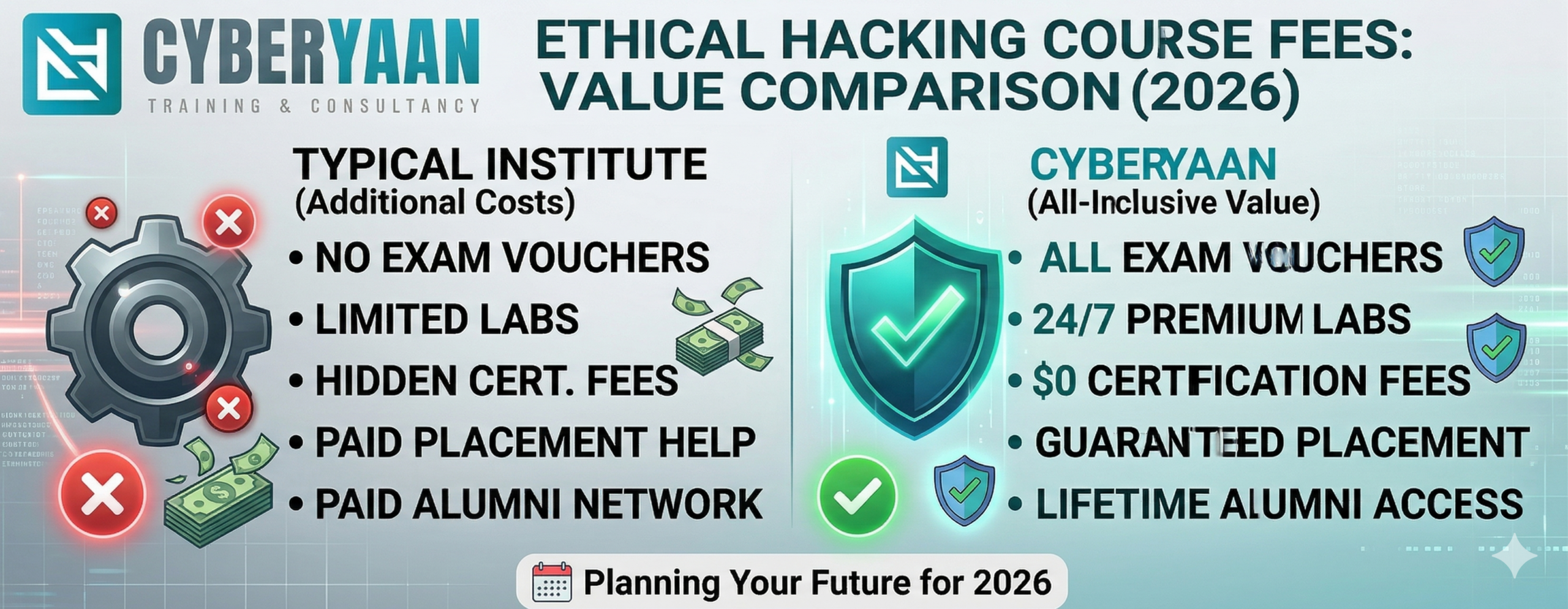
Here is a direct comparison of what Cyberyaan’s ethical hacking course fees include versus what you typically get from budget programs in Delhi charging ₹15,000–₹30,000:
COMPLETE CURRICULUM (15+ modules, updated 2026):
Cyberyaan: Included
Budget Institutes: Partial — typically 8–10 outdated modules
HANDS-ON LAB ACCESS (full course duration):
Cyberyaan: Included
Budget Institutes: Limited or charged separately
CEH EXAM GUIDANCE AND MOCK TESTS:
Cyberyaan: Included
Budget Institutes: Usually not included
STUDY MATERIALS AND TOOL SETUP SUPPORT:
Cyberyaan: Included
Budget Institutes: Basic PDF handouts only
PRACTITIONER TRAINERS WITH INDUSTRY EXPERIENCE:
Cyberyaan: Yes
Budget Institutes: Inconsistent — often academic-only
STRUCTURED PLACEMENT SUPPORT:
Cyberyaan: Yes — dedicated process
Budget Institutes: “We help with placement” (unstructured)
SMALL BATCH SIZES FOR INDIVIDUAL ATTENTION:
Cyberyaan: Yes
Budget Institutes: Often 40–60+ students per batch
POST-COURSE MENTORSHIP:
Cyberyaan: Available
Budget Institutes: Rarely offered
WHAT THE RIGHT ETHICAL HACKING COURSE FEES SHOULD FEEL LIKE
Paying ethical hacking course fees should feel like an investment with a clear return — not an expense with uncertain outcomes.
If a course costs ₹80,000 and places you in a job at ₹4.5 LPA, you recover the full fees in under three months of your first salary. If a course costs ₹25,000 and leaves you unprepared for interviews — because the lab was inadequate, the curriculum was outdated, and placement support was nonexistent — you’ve wasted both money and time, and now face the cost of retraining. The lowest ethical hacking course fees in Delhi are not the most affordable option. The most affordable option is the one that gets you placed.
Cyberyaan’s ethical hacking course fees are structured to reflect the full cost of doing this right — quality trainers, real labs, updated curriculum, certification guidance, and genuine placement support. Every rupee in that fee is traceable to something that directly improves your career outcome.
That is the only honest way to evaluate ethical hacking course fees — not by the number, but by what’s behind it.
CONCLUSION
The next time you compare ethical hacking course fees between institutes, don’t just look at the number at the bottom of the brochure. Look at what’s included in that number — and what isn’t.
Ask about lab access. Ask about certification exam vouchers. Ask about trainer credentials. Ask for specific placement data. Ask about batch sizes. Ask what happens after the course ends.
An institute that can answer all of these questions confidently and transparently is worth paying for. One that deflects or gives vague answers is telling you something important about what your fees will actually deliver.
At Cyberyaan, every one of those questions has a clear, honest answer. And that transparency — knowing exactly what you’re paying for before you pay — is itself one of the most valuable things we offer.
FREQUENTLY ASKED QUESTIONS
Q: What is the ethical hacking course fees at Cyberyaan?
A: Contact Cyberyaan directly at +91 7428748576 or training@cyberyaan.com for current fee details, batch schedules, and any available EMI options.
Q: Does the fee include the CEH exam voucher?
A: Speak with a Cyberyaan counselor to get a complete breakdown of what is included in the current fee structure and what certification costs look like.
Q: Are there EMI options available for the course fees?
A: Yes, financing options are available. Contact Cyberyaan for details on installment plans that fit your budget.
Q: What is the duration of the ethical hacking course at Cyberyaan?
A: Cyberyaan offers flexible batch options — weekday, weekend, and fast-track formats. Duration ranges from 3 months to 1 year depending on the program chosen.
Q: Is lab access included in the fees?
A: Yes. Hands-on virtual lab access is included throughout the duration of the course — not charged as a separate add-on.
CONNECT WITH US